Under Sink Grease Interceptor Ratings, 7-150 GPM
The short of it
- A point of use unit sits under greasy fixtures and is rated in GPM, not gallons; Canplas indexes its Endura line from 7 to 150 GPM.
- The GPM figure is tested flow, the pounds figure is rated grease retention, and neither is tank volume.
- Bloomington, Indiana requires service at least every 90 days, or sooner once waste reaches 25% of wetted depth.
- Trained staff can open and clean a point of use body, but an in ground tank is confined space work.
- If the sink still drains slowly behind a clean strainer and a serviced body, the restriction sits downstream.
An under sink grease interceptor is a point of use unit plumbed into a three compartment or prep sink drain, rated in gallons per minute. Canplas indexes Endura models from 7 to 150 GPM. It catches fats, oils and grease at the fixture. Two label numbers decide the fit, flow in GPM and grease capacity in pounds, and neither is tank volume.
Where an under sink grease interceptor is allowed, and what it connects to
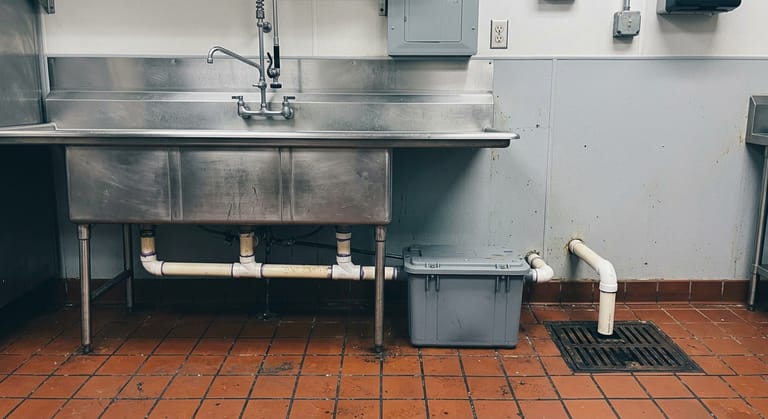
An under sink unit serves greasy fixtures only: the three compartment warewashing sink, prep sinks and sometimes the dishmachine drain. Restroom and sanitary lines stay out.
The tie-in is code work: food equipment gets no hard connection to the drainage system. In Section 802.1.1 of the IPC 2021, adopted in the Delaware Plumbing Code 2021, every fixture where food is stored, prepped or handled "shall discharge through an indirect waste pipe by means of an air gap," open space between the pipe outlet and the receptor rim.
Warewashing sinks are treated separately, in Section 802.1.7, which accepts an air gap or the looser air break. Section 802.3.2 puts that break "between the indirect waste pipe and the trap seal of the waste receptor": the pipe may run down inside the receptor, below its rim, but must stop short of the trap water.
What the label tells you: GPM, pounds and the seal
| Line on the label | What it means | What it does not mean |
|---|---|---|
| Flow rate, GPM | Tested and rated flow | Not tank gallons |
| Grease capacity, pounds | Rated grease retention | Not time between cleanings |
| Certification seal | Tested to a named standard | Not your sewer authority's approval |
The Jay R. Smith interceptor technical data pairs 20 GPM with 40 pounds of rated grease capacity and 50 GPM with 100 pounds, twice the GPM figure across that series. The full series sits on our hydromechanical grease interceptor page. Smith names no certifying standard there, so read the pairs as a manufacturer rating, not a code rule.
PDI G101, revised 2017, is a testing and rating procedure for grease interceptors. PDI keeps testing equipment in independent laboratories, issues a certificate for each interceptor tested, and treats the seal as evidence the product met the Institute's standards. Use of it is voluntary and does not bar units that fall short, so the force comes from whichever code your city adopted. ASME lists the other common mark as A112.14.3/CSA B481.1, a 2022 edition.
Zurn's GT2700, in the 4 inch no hub configuration with flow control, is rated 75 GPM and described by Zurn as PDI certified. For its 10 to 15 GPM units Zurn states a flow control device is required upstream, venting odors, regulating flow and supplying an air cushion for separation. Sizing a sink to GPM is separate arithmetic: see the published sizing methods.
Low profile and under counter models for a tight cabinet
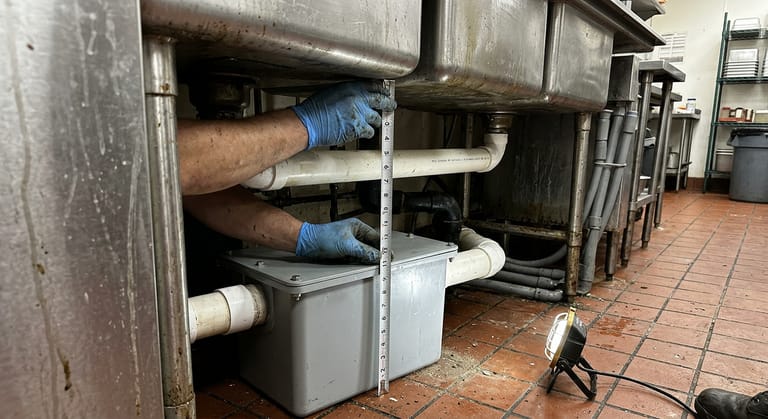
Canplas publishes an Endura interceptor index running 7-10 GPM, 15-20 GPM, 35 GPM and 50 GPM, plus an Endura Lo-Profile rated 25 GPM and an XL series covering 75 to 150 GPM as the XL75, XL100 and XL150. Pounds of grease capacity are not on that index; pull the model sheet.
Low profile means a shorter body for a cabinet that cannot take standard height, and the trade is footprint. Measure clear height under the bowl and the room to lift the cover straight up; a cover that cannot come up gets skipped.
Talk to someone who opens these lids every week
Call (800) 555-0184Free to dial. Whoever answers pumps and services grease interceptors; ask for the registration number your city requires while you are on the call.Partner haulers and plumbers who work on food service drains- Partners who pump interceptors, not just unclog sinks
- Answered during the dinner rush
- Dialing costs nothing and books nothing
Above ground grease interceptor, floor mounted or recessed
The same point of use body gets installed three ways: under the counter, above ground on the floor beside the fixture, or recessed into the slab with its cover flush to the floor. Floor mounted opens easiest and costs aisle space; in floor keeps the aisle clear but its cover takes foot traffic; under the counter keeps the run short where clearance is tightest.
One naming caution: many ordinances use interceptor for the outdoor tank and trap for the small indoor device, so in a permit conversation above ground grease interceptor can mean nothing more than "not the tank outside".
Stainless steel grease interceptor, coated steel or a plastic body
Material confers no rating: flow and retention come from the test, not the metal. A stainless steel grease interceptor is the usual pick where the body is visible or gets washed down with the floor, and where coated steel would rust at the seams and cover lip. Coated steel costs less and does fine in a dry cabinet while the coating holds.
Plastic bodies do not corrode, but they carry a temperature limit. The Schier sheet for its polyethylene GB-1000-B, a below grade model rather than an under counter one, states "Maximum operating temperature: 150° F continuous", calls for a drain water tempering valve and approved backflow prevention assembly above that, and notes that most state and local plumbing codes prohibit discharging water above 150 F to the sanitary sewer. If a dishmachine drains toward your unit, find that line on your model's sheet.
How often it needs service, from the manual and from the city
Automatic and passive units keep different rhythms. Thermaco's instructions for the Big Dipper automatic grease removal unit tell the operator to empty the clear plastic grease and oils collection container once each day, before it becomes full, and to wash it so it stays translucent. The passive LD-200 (up to 20 GPM), LD-250 (25 GPM) and LD-750 (75 GPM) hold everything inside until somebody opens them.
For a passive body, the city writes the schedule. Bloomington, Indiana requires service at least every 90 days, or sooner once accumulated waste reaches 25% of the unit's wetted depth, a rule written for interceptors on its sanitary sewer. Other cities' triggers sit on what your ordinance requires and how often; where the removed load goes is on grease trap pumping.
The prep sink that drains slower every week
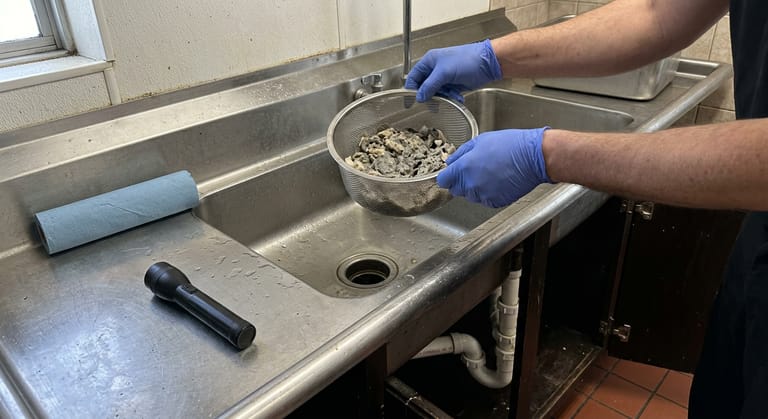
A timer and a flashlight tell you which half of a slowing basin you own.
- Fill the prep sink, pull the plug and time the drain. Write the number down.
- Pull the strainer basket and clean the inlet fitting: a packed basket slows a fixture long before the body is full.
- Open the cover and read two layers, the grease cap on top and the sludge on the bottom. A trade cleaning source treats those thicknesses against total liquid depth as field compliance, a working description rather than a code test; compare yours with your city's published threshold.
- Have the unit cleaned, collect what comes out in a sealed container for approved disposal, and time the basin again.
If the basin clears, the unit was the whole story and the fix is scheduling; grease trap cleaning covers what a service visit includes.
If it still drains slowly behind a clean strainer and a serviced body, the restriction sits downstream, in the branch line or the main: that is restaurant drain cleaning work, not pumping.
Calling (800) 555-0184 puts you with a partner company working your area. Silverbeck writes about this equipment and runs none of it, so tell whoever answers what you timed, what you measured and what your city requires.
Often no call is needed. An under sink grease interceptor inside its interval, opened on schedule by trained staff and emptied into a sealed container with an approved disposal route, is a kitchen job. Keep the log: it is the evidence an inspector asks for first.