How Often a Grease Trap Must Be Cleaned, 30-90 Days
The short of it
- No federal interval exists; your city sets it, from every 30 days in Phoenix to 90 in Dallas.
- Whichever comes first governs: the calendar interval, or the 25 percent fill trigger your ordinance names.
- No enzyme or bacteria product resets the clock, and New York, Phoenix and Portland ban additives outright.
- Phoenix requires records kept at the facility for a minimum of three years, and inspections arrive unannounced.
- You can check dates and the log sheet, but opening a buried unit is confined-space work for a trained hauler.
Your city writes the number, not the federal government: Phoenix requires hydromechanical interceptors emptied every 30 days and never past 90, while Dallas sets a floor of 90.
Dallas hangs a second trigger on that floor. Service comes sooner once 25 percent or more of the tank holds floating materials, sediment, oils or grease. Calendar or fill, whichever arrives first governs, which is why the honest answer to how often should a grease trap be cleaned is two numbers, not one.
Federal rules do not fill the gap. EPA's food service fact sheet (EPA-833-F-12-003, September 2012) says only that maintenance frequency for these devices "depends greatly on the amount of FOG a facility generates". No interval, no fill percentage, nothing to pin on a wall calendar.
Silverbeck is a publisher and runs no trucks. If your last service date has already slipped, calling (800) 555-0184 reaches a partner hauler who can put a dated manifest back in your file.
How often should a grease trap be cleaned, and who decides
The answer is local by federal design. 40 CFR 403.5(c)(1) directs every POTW building a pretreatment program to "develop and enforce specific limits" that carry the federal prohibitions into local law. Paragraph (d) gives those local limits federal weight: they "shall be deemed Pretreatment Standards" for section 307(d) enforcement.
So the enforceable figure sits in a sewer use ordinance or a discharge permit, not in a national rulebook, and two kitchens four miles apart can run on different intervals if a city line falls between them.
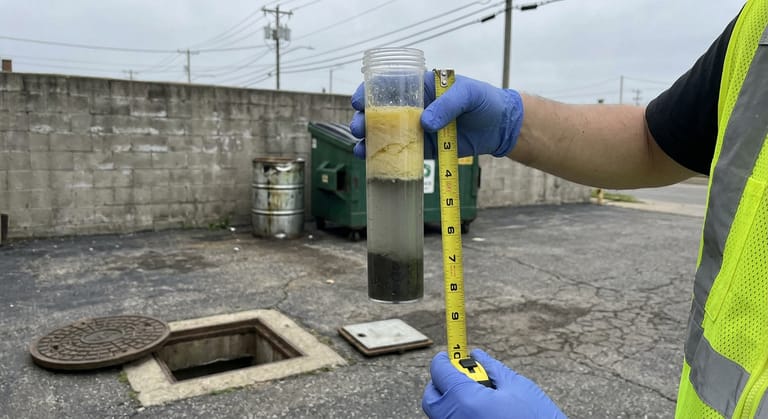
The 25 percent rule, word for word
Most programs pair the calendar with a fill limit, and the fill limit is the one that surprises kitchens. New York City writes it as a depth. 15 RCNY § 19-11(q) puts the ceiling in the tank itself: accumulated FOG and solids must "not exceed 25% of the total liquid depth" the device was designed to hold.
Portland, Oregon states the trigger in plain words, putting most interceptors on the truck once they sit "25 percent full of FOG and solids". Phoenix's 2024 FOG BMP manual uses the device itself as the ruler, calling for a full cleaning once FOG and solids occupy "greater than 25% of the interceptor's capacity".
Grease trap cleaning schedule, city by city
Eight programs, no two written alike. Where a document stated no figure, the cell says so.
| City or authority | Where the rule sits | How the trigger is worded | Required frequency | Records kept |
|---|---|---|---|---|
| New York City | 15 RCNY § 19-11, eff. 3/19/2020 | FOG and solids not to exceed 25% of designed total liquid depth | No calendar interval stated; routine cleaning as needed | Yellow grease collection proof, on site 1 year |
| Phoenix | City Code ch. 28; FOG BMP manual, 2024 | Full cleaning above 25% of device capacity | Hydromechanical every 30 days, never beyond 90; gravity every 3 months | 3 years, at the facility |
| Dallas | City Code vol. I, ch. 19, art. X | 25 percent or more holding floating materials, sediment, oils or grease | At least every 90 days | 3 years, on the premises |
| Houston | Code of Ordinances ch. 47, Water and Sewers | 25 percent trigger, as reported in program summaries; ordinance wording and measurement basis not read | Fully evacuated quarterly unless a Notice of Waiver is approved | Generator copies 5 years, on site |
| Bloomington, IN | City FOG maintenance procedure | Reported: 25 percent of wetted depth, static water level to tank bottom | At least every 90 days | Not stated |
| Philadelphia | PWD Regulations 502.8(a) | Not stated in the documents checked | Not stated | At least 3 years |
| Portland, OR | BES FOG program | Most interceptors need cleaning at 25 percent full | Routine cleaning, frequency set case by case | Report filed with the City after every cleaning |
| Los Angeles | LAMC Sec. 64.30 | Not stated; the code requires an Industrial Wastewater Permit and an approved gravity interceptor | Not stated | Not stated |
Not every authority writes an interval at all. The Metropolitan Water Reclamation District of Greater Chicago regulates the discharge instead, with a local limit of 250 mg/L for fats, oils and greases in its Sewage and Waste Control Ordinance, so a Cook County kitchen is judged by what leaves the interceptor rather than by a calendar.
So how often should a grease trap be cleaned when the legal floor looks generous next to what your tank is actually doing? The Phoenix manual treats its interval as a minimum and tells new facilities to raise frequency to match buildup.
That distinction matters at the sink. The floor is the latest date you may go, not a schedule matched to your menu: a fry-heavy breakfast counter on a small indoor unit can reach the threshold in three weeks. Ask the hauler what fill level was found and log it; two full traps in a row means the interval belongs earlier.
Grease interceptor maintenance between pump-outs
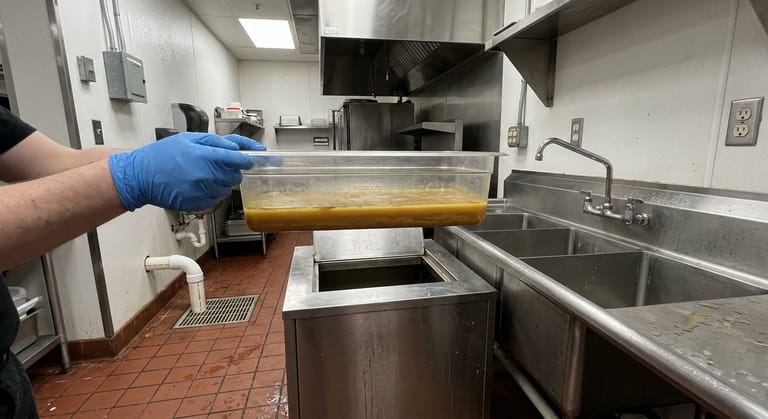
Grease interceptor maintenance is not only the visit. EPA hedges the payoff, promising only that good practice can reduce how often the interceptor needs servicing. Treat that as possible savings, not permission: the interval in your ordinance moves only when the authority agrees in writing.
Thermaco's guide for the Big Dipper automatic grease removal unit puts a daily task on staff: empty the clear collection container once each day, before it becomes full, and wash it periodically so it stays translucent. That container is a point-of-use job for a cook. A buried tank is not. A passive under-sink interceptor has a different routine, and a trap that keeps missing its interval is usually a sizing problem, not a scheduling one.
Talk to someone who opens these lids every week
Call (800) 555-0184Free to dial. Whoever answers pumps and services grease interceptors; ask for the registration number your city requires while you are on the call.Partner haulers and plumbers who work on food service drains- Partners who pump interceptors, not just unclog sinks
- Answered during the dinner rush
- Dialing costs nothing and books nothing
Additives will not stretch the interval
No dosing product resets the clock, and in several cities pouring one in is itself the violation. New York City's rule, 15 RCNY § 19-11(u), bans "emulsifiers, enzymes, chemicals, microbial agents, or other additives" outright. Phoenix draws the same line for its establishments, barring chemicals, enzymes, proteins, bacteria, solvents or emulsifiers used to dissolve FOG.
Portland prohibits additives regardless of composition under Administrative Rule ENB-4.26, and its reasoning is practical: enzymes only change FOG temporarily, and bacteria need steadier conditions than a trap offers. Grease loosened rather than captured still leaves the building. What each product family does to grease, city by city, is on the cleaning tools page.
Your grease trap cleaning log and the service manifest
Two records do different jobs. The log is the sheet kept at the kitchen with dates and observations; the manifest is the control document that follows the waste off your property.
Kaufman, Texas puts the duty on both parties: each pump-out is accompanied by a manifest, and whoever generates, collects and transports the waste keeps a record of each collection and deposit. Dallas runs a formal version, a five-part trip ticket used by liquid waste transporters, with the establishment keeping its copy as proof of service.
Greensboro, North Carolina shows what the record has to carry: cleanout reports filed electronically each time the trap is cleaned, listing the date cleaned, the liquid volume removed, and the disposal location, with receipts submitted within 14 days.
What an inspector actually asks for
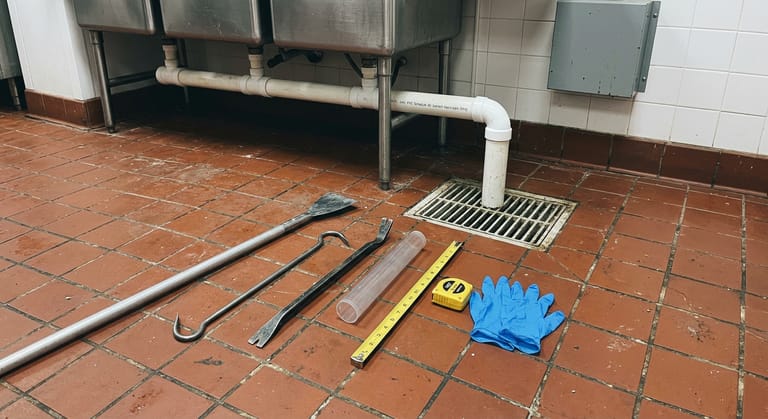
In Dallas, a Water Utilities Liquid Waste Inspector verifies that the trap has been serviced at least every 90 days and asks to see the manifests from a permitted transporter.
Phoenix expects that file to be waiting in the building. Its manual requires records and documentation "available at the facility or site for a minimum of 3 years from the date created", third-party contractor invoices included, and inspections arrive unannounced. A binder at the corporate office does not satisfy that sentence.
New York adds a physical duty: under 15 RCNY § 19-11(h), establishments must open their units for DEP inspection on request and keep the necessary tools readily available. DEP's guidance page for businesses says the maximum penalty "is currently $10,000 per day, per violation."
The last manifest is older than 90 days, or nobody can find one
How often does a busy kitchen need service where the paperwork has gone missing? Treat the trap as overdue until a dated record proves otherwise, then spend two minutes on this.
- Pull the last manifest copy, trip ticket or hauler invoice and read the printed date, not the remembered one.
- Compare it with your city's interval. Dallas and Houston write 90 days; Phoenix writes 30 for indoor hydromechanical units.
- Check the log sheet at the trap. A missing entry is a finding where records must be kept on site.
- Note the device. An indoor hydromechanical trap and an outdoor gravity tank are not on the same schedule in Phoenix.
Then it stops. Do not open, climb into or reach inside an in-ground trap: measuring the grease cap and sludge depth means opening and entering a buried tank, which is confined-space work for an equipped hauler. Phoenix requires the tank left completely empty after pumping, so a quick skim does not reset the interval. A full visit is covered on the cleaning and pumping pages.
If the date sits inside your interval and the trap is under the threshold, you do not need to call anyone. If the record is past due, missing, or the last visit was a skim, call (800) 555-0184 and get a dated manifest back in the file before the next inspection.