Grease Trap Cleaning Done Right in 7 Steps
The short of it
- A complete visit empties the tank entirely, scrapes the walls and baffles, then refills it with water.
- New York City holds accumulated fat, oil, grease and solids to 25% of total liquid depth.
- Kitchen staff empty strainers and an automatic unit's collection container daily, but a below-grade vault belongs to a hauler.
- Never enter the trap: a below-grade vault is judged against federal OSHA's confined-space rule, and entry is permit work for an equipped crew, never kitchen staff.
- Ask for paper naming the date, volume removed and disposal destination, because no paper is itself a finding.
Grease trap cleaning means total evacuation, cap, water and sludge, then scraping the walls, baffles and outlet tee, then a refill. New York City holds accumulated fat, oil, grease and solids to 25% of total liquid depth. A skim answers neither half of that.
That ceiling is 15 RCNY § 19-11(q), which counts fat, oil, grease and solids together against the total liquid depth the unit was designed to hold; the sentence is quoted word for word on the interval page. Note the word solids.
Silverbeck writes about this equipment and pumps nothing. If your tank is due, (800) 555-0184 reaches a hauler or plumber who can read the paperwork and the interior and say which visit you need.
What a real grease trap cleaning includes
Five things separate a complete visit from a short one.
- Total evacuation, liquid and solids together, not the floating cap alone.
- Scraping of walls, baffle faces and fittings while the tank is empty.
- A look at the outlet tee and the inlet with the interior visible.
- Refilling with water so the unit works on the next shift.
- Paper left behind naming the date, the volume removed and the destination.
Windsor Heights, Iowa builds its interceptor maintenance ordinance (section 100.62) around complete pump-out: fully evacuated, cleaned and inspected.
EPA never names a number of days. Its food service fact sheet hangs frequency on two variables, how much FOG the kitchen generates and which best management practices run behind the line, and it asks establishments to be "diligent" about servicing their interceptor and collector devices at regular intervals. Two kitchens with identical tanks therefore land on different calendars: a fryer-heavy menu fills a unit in weeks, a sandwich station takes months. Working that number out for your own kitchen is the subject of how often to clean a grease trap.
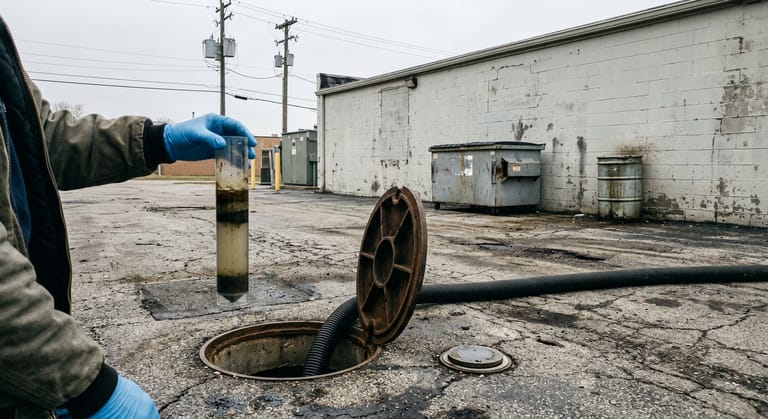
Cleaning out a grease trap: the visit step by step
Here is how a thorough visit runs at the lid.
- Access. Lids come off, the approach is protected. Access is the kitchen's side of the job: under 15 RCNY § 19-11(h), NYC DEP requires establishments to "open their grease interceptors and automatic grease removal devices for inspection by the Department upon request" and to keep the tools for that within reach. Indoor covers staff lift; a below-grade lid comes off in the hauler's or plumber's hands. The kitchen's part is knowing where the tools are kept and that nobody has parked a dumpster or stacked a pallet over the frame.
- Measurement before anything moves. Trade practice records cap depth at the surface, sludge depth at the bottom, and the two combined as a share of liquid depth. Field method rather than code, but it produces the number a city threshold is compared against, and only an undisturbed tank reads true.
- Total evacuation. The cap, the entire water column and the sludge blanket all come out. On an in-ground trap that is vacuum work with a hose and an equipped truck, covered on grease trap pumping.
- Scraping. Walls, baffle faces, the underside of the lid and the fittings. Hardened residue left on a wall is the seed for the next cap.
- Inspection with the tank empty. The only moment anyone sees the interior. Outlet tee, baffles and inlet fitting get checked for damage and displacement.
- Refill with water. A dry trap separates nothing, so it is refilled before the kitchen opens.
- Paperwork. Date, volume removed, disposal destination, signatures.
What gets scraped when cleaning a grease trap
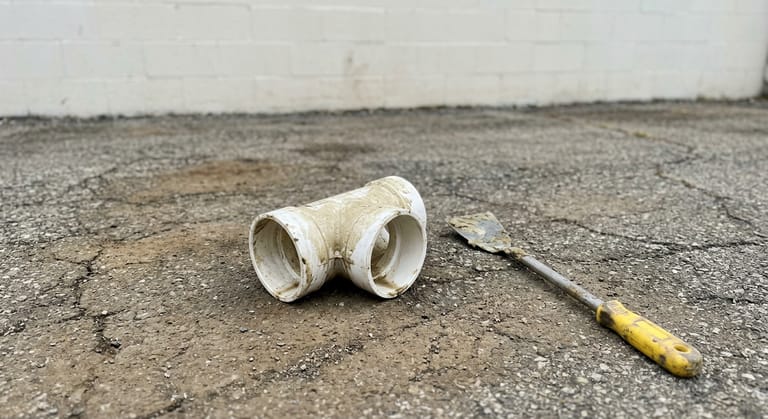
A pumped but unscraped tank fouls again quickly, and the parts that matter are the ones a hose never reaches.
Baffles slow the flow so it separates instead of shooting across to the outlet. Separation is the design intent, and EPA's food service fact sheet names the condition it needs: the unit has to let FOG "cool and separate in a non-turbulent environment". A baffle caked over, cracked or knocked off its seat stops delivering that condition, and suction does not put it back. It also explains a tank that is pumped on schedule and still passes grease downstream: dishwater is crossing it too fast to give anything up.
The outlet tee draws from below the floating layer, so the cap stays put instead of leaving with the effluent. New York attaches a figure to that job at 15 RCNY § 19-11(f): a unit must "remove an average of 90 percent or more of the grease" or other extractable matter carried in the wastewater, measured before its rated grease retention capacity is exceeded. Break that tee, or let it wash out of its socket, and the lid still shows a normal-looking tank while the outlet quietly feeds cap into the building line.
Subdivision (g) of the same rule caps water entering the unit at 180°F, except where only hotter lines feed it, and subdivision (k) keeps high temperature sanitizer cycles off it. Water that hot carries FOG straight through with no chance to cool.
Emptied on schedule and still running over? Interceptor versus trap sorts out which device you have.
Talk to someone who opens these lids every week
Call (800) 555-0184Free to dial. Whoever answers pumps and services grease interceptors; ask for the registration number your city requires while you are on the call.Partner haulers and plumbers who work on food service drains- Partners who pump interceptors, not just unclog sinks
- Answered during the dinner rush
- Dialing costs nothing and books nothing
Cleaning grease trap units under the sink, and where that stops
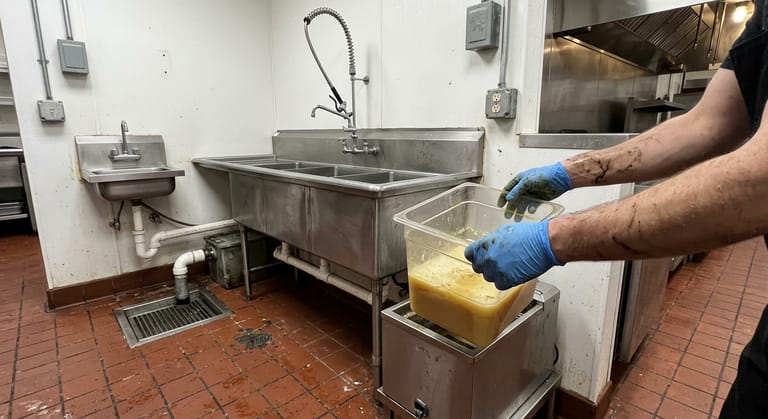
An operator can maintain a point-of-use unit by hand. A below-grade vault is another category of work.
Small hydromechanical units under a three-compartment sink get strainers emptied, the interior cleaned and the gasket checked, a routine covered on under-sink units. Automatic units add a daily task: Thermaco's instructions for the Big Dipper W-series say the clear plastic grease and oils collection container is to be emptied before it becomes full, once each day, and washed so it stays translucent. A self-cleaning grease trap still needs a person on a shift schedule.
Additives replace none of this: New York bans emulsifiers, enzymes, chemicals and microbial agents outright, and what belongs in a service kit is listed separately.
| Task | Kitchen staff | Partner hauler or plumber |
|---|---|---|
| Emptying strainer baskets | Yes, every shift | No |
| Emptying an automatic unit's collection container | Yes, daily per Thermaco's instructions | No |
| Reading cap and sludge depth at an accessible indoor lid | Yes | Yes, before evacuation |
| Vacuum evacuation of an in-ground trap | No | Yes |
| Scraping walls and baffles inside a vault | No | Yes |
| Replacing a broken outlet tee | No | Yes |
| Entering the trap | Never | Permit-required confined space work only |
Federal OSHA's three-part confined-space definition at 29 CFR 1910.146, quoted in full on the pumping page, is the rule a below-grade tank is judged by, and entry under it is permit work.
Grease interceptor cleaning records the inspector asks for
The load leaving your property is tracked, and the generator shares that duty: Kaufman, Texas requires a manifest with each pump-out, kept by everyone who handles the waste. What each city requires, and for how long, is on the interval page.
A bad visit leaves the trap half full
Skim only. The cap comes off, the truck leaves, the invoice says cleaned. The sludge blanket stays, and it counts: the threshold measures grease and solids together against liquid depth.
Contents sent down a drain. Local ordinances forbid it, and federal pretreatment law stands behind them. 40 CFR 403.5(b)(3) reaches solid and viscous material discharged in quantities that block a public treatment works and cause Interference, and the interceptor hub carries that sentence in full. EPA quotes its own 2004 report to Congress, which puts grease from restaurants, homes and industry at "the most common cause (47%) of reported blockages" in sewer lines. The mechanism is candle wax: warm grease enters as liquid, stiffens against a cool pipe wall and narrows the bore until the flow stops.
A grease trap cleaning that skips the scrape is a visit you buy twice. What a full evacuation runs is broken down separately.
When cleaning the grease trap cannot wait
Three things put an operator at the lid fast: a floor sink draining slower every shift, an odor in the dining room, an inspection date a week out.
The two-minute check stops at an indoor lid. Pull the strainers, open the under-sink cover and compare the floating layer against liquid depth: cap and solids nearing a quarter of it puts you at the 25 percent line New York writes into its rule. Then read the date and volume on the last service paper. No paper is itself a finding.
For a below-grade tank: is the lid reachable, is there residue around the frame, when was the last manifest issued. Leave that lid closed; opening it is the hauler's job.
A hauler owns the grease trap cleaning itself: vacuum evacuation, scraping the interior, a manifested load to an approved facility. A plumber owns what is left when a line still drains slow behind a clean tank, a broken outlet tee, or a fixture never tied in. Two different calls, and the number above sorts out which.
Talk to someone who opens these lids every week
Call (800) 555-0184Free to dial. Whoever answers pumps and services grease interceptors; ask for the registration number your city requires while you are on the call.Partner haulers and plumbers who work on food service drains- Partners who pump interceptors, not just unclog sinks
- Answered during the dinner rush
- Dialing costs nothing and books nothing