Gravity Grease Interceptor Tanks, 500 to 15,000 Gal
The short of it
- A buried gravity tank has no moving parts and no power; retention time alone does the separating.
- Table 1014.3.6 starts at 500 gallons and runs to 15,000, sized from drainage fixture units rather than seats.
- Bloomington, Indiana requires service at 25 percent of wetted depth, and at least every 90 days regardless.
- Reading the grease cap and sludge in a buried tank is the hauler's job with a depth sampler; staff keep the dates and the last measured depths on file.
- Gallons measure tank volume and gpm measures flow, so a 100 gpm unit is not a 100 gallon one.
A gravity grease interceptor is a large in-ground tank, from 500 gallons up, that holds kitchen wastewater long enough for grease to float and solids to sink before the water leaves. The smallest liquid volume in Table 1014.3.6 of UPC Section 1014.3 is 500 gallons, and the rows climb to 15,000. No moving parts, no power, no filter media. Retention time does all of the work.
Section numbering follows the 2021 Uniform Plumbing Code as adopted in the Hawaii Plumbing Code and served by UpCodes, so check it against the edition your authority having jurisdiction enforces. Whether a kitchen needs a buried tank at all is compared on the interceptor and trap page.
Volume, service interval and lid access are local questions. A call to (800) 555-0184 reaches an independent company that services these tanks, and a hauler working that city can say what interval each size tends to produce there and whether a truck can reach the lid on the plan.
The volumes in the code table, from 500 gallons up
Table 1014.3.6, as rendered on UpCodes, lists thirteen liquid volumes: 500, 750, 1,000, 1,250, 1,500, 2,000, 2,500, 3,000, 4,000, 5,000, 7,500, 10,000 and 15,000 gallons. A 750 gallon grease interceptor and a 2000 gallon grease interceptor are rows in the same table rather than different products, and a quote may write the same tank as 1000 gal or 1,000 gallon, 1500 gal or 1,500 gallon. The fixture-unit column that drives the choice is reproduced, with its caveat, on the sizing page.
Section 1014.3.6 derives the volume from drainage fixture units, and where that count is unknown it falls back to the maximum allowed for the pipe size feeding the inlet. Seats, covers per night and menu style appear nowhere in the method, so treat "a 60 seat restaurant needs 1,000 gallons" as a guess wearing a lab coat.
Concrete grease interceptor, polyethylene, fiberglass and steel
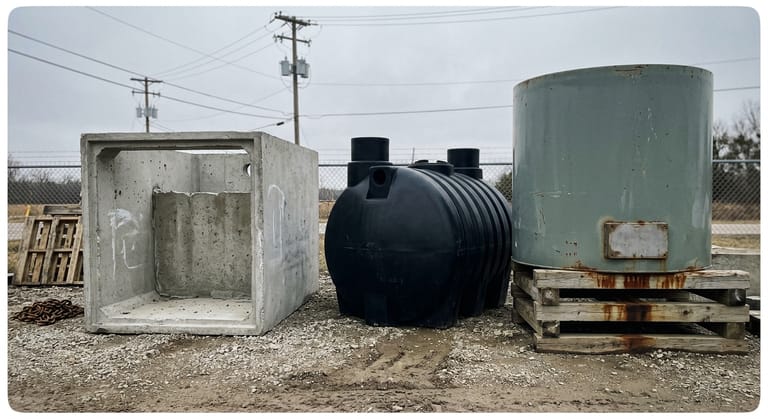
The code declines to pick a material. UPC 1014.3.3 states: "Gravity interceptors shall be constructed in accordance with the applicable standard in Chapter 17 or the design approved by the Authority Having Jurisdiction." The buyer's question is not which material wins in general, but which construction the sewer authority will approve and which standard the supplier names on the submittal.
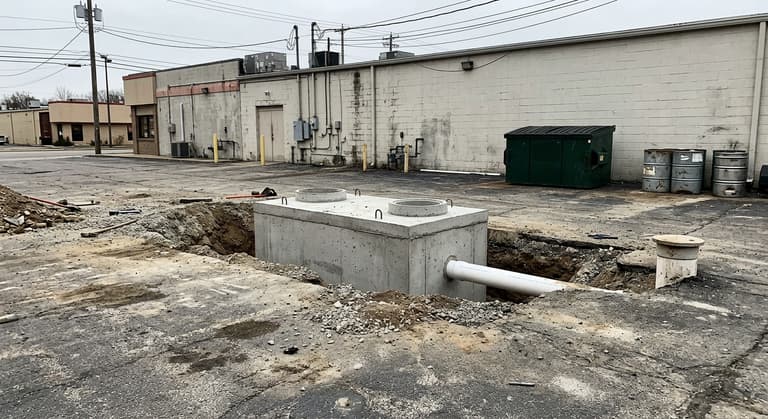
Precast concrete. The buried class is dominated by precast: a precast concrete grease interceptor arrives as castings, set into an excavation and joined on site. The weight is why it lives outdoors, and why delivery access gets settled before the truck shows up. What the excavation and the castings do to a quote is broken out on grease trap installation cost.
Steel. Highland Tank describes its passive grease interceptors as built to accept gravity flow and to hold wastewater long enough for liquefied grease to cool, separate and congeal, floating to the surface while solids settle at the sludge baffle (product literature). Steel lives or dies on its coating system: on the rectangular aboveground passive line the same manufacturer specifies an exterior polyurethane coating plus an acid-resistant internal polyurethane lining against hydrogen sulfide damage.
Polyethylene and fiberglass. Lighter bodies get chosen where a heavy casting cannot be craned into a tight site. MIFAB's LIL-MAX is one HDPE body, though its ratings and listing were not among the documents reviewed for this page, and no fiberglass tank literature was reviewed either. With either material, the submittal has to name the Chapter 17 standard, or the approval from the authority having jurisdiction, that UPC 1014.3.3 asks for.
Two compartments, a baffle and an outlet tee
Inside, a gravity grease interceptor is usually split into two compartments by a baffle wall: the first absorbs the rush of a scullery sink emptying at once, the second is quieter, and the outlet tee draws from the middle of the water column, below the floating cap and above the settled sludge. Section 1014.3.2 allows grease-bearing fixtures such as scullery sinks, pot sinks, dishwashers and floor drains to discharge through the tank, while water closets and urinals must not. What a plan reviewer checks is collected under the venting, cleanout and access rules.
Talk to someone who opens these lids every week
Call (800) 555-0184Free to dial. Whoever answers pumps and services grease interceptors; ask for the registration number your city requires while you are on the call.Partner haulers and plumbers who work on food service drains- Partners who pump interceptors, not just unclog sinks
- Answered during the dinner rush
- Dialing costs nothing and books nothing
Where an exterior gravity grease interceptor sits and how it opens
Outside, buried in a yard, service drive or parking area, downstream of the kitchen lines and upstream of the sewer connection. UPC 1014.3.4 asks that the unit stay easy to reach for inspection, cleaning and grease removal, that it be readily accessible to maintenance equipment, and that it sit close to the fixtures it serves; the wording itself is reproduced in full with the permit rules.
Read that as two site questions: can the lids be opened at grade without lifting gear, and can a pump truck park close enough that its hose reaches without blocking a delivery lane?
Tank volume in gallons is not a flow rating in gallons per minute
These two numbers get swapped constantly. A buried tank is rated by the liquid it holds, in gallons; a point-of-use unit is rated by the flow it can take, in gallons per minute, with a paired capacity in pounds. So a 100 gpm grease interceptor is a flow rating, a 100 gallon grease interceptor is a volume, and neither converts into the other by arithmetic. That rating series belongs to hydromechanical units, not to tanks in the ground.
The code's one bridge between the two sits in Section 1014.3.6: flow rate times 30 minutes of retention, for fixtures that carry no fixture-unit value, added to what the table gives. That subsection is quoted and worked through on the same sizing page.
How a hauler empties it
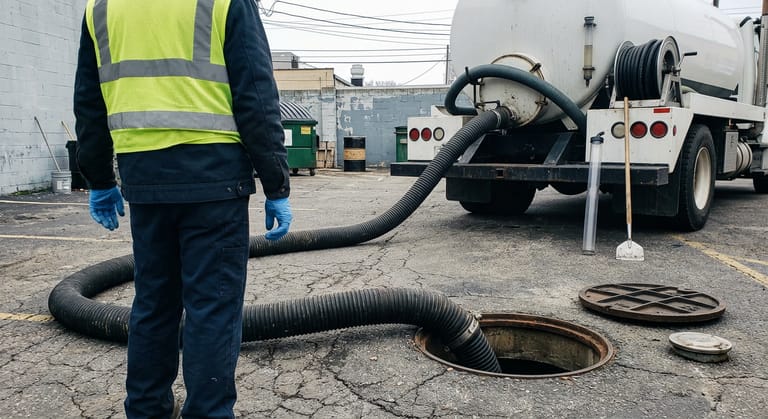
Emptying a gravity grease interceptor means removing everything, not skimming the top. The Windsor Heights, Iowa section on operation, maintenance and cleaning (100.62) calls for the unit to be fully evacuated, cleaned and inspected on a fixed maximum interval, with the load taken to a water reclamation facility or another approved facility rather than back into a private or city sewer.
Bloomington, Indiana's maintenance procedure requires service at least every 90 days, or sooner if accumulated waste, floatable and settleable together, reaches 25 percent of the wetted depth measured from the static water level to the interior tank bottom. Manifests, cleanout reports and receipt deadlines are covered on the pump-out visit page, and how the threshold turns into a schedule is on the service interval page.
A 1000 gallon grease interceptor next to a 1500 gallon grease interceptor
These two sit one row apart in the code table and often arrive as two lines on the same installation quote. A gravity grease interceptor does an identical job at either size. What changes is how many days pass before the grease cap and sludge layer hit the threshold your city measures.
A quote with two lines, 1,000 gallons at one price and 1,500 at another, gets settled by paperwork rather than opinion.
- Compare the fixture list the quote was built from against what will really drain into the tank. Restrooms do not belong on it.
- Get two numbers from the sewer authority: the longest interval between pump-outs it allows, and the accumulation threshold that forces early service.
- Find where the lids land on the site plan. Under a dumpster pad or in the only delivery lane, the cheaper tank stops being cheaper.
Then the question that settles it: at each volume, how often does a truck have to come? The tank is bought once; pump-outs are bought for as long as the kitchen runs.
Talk to someone who opens these lids every week
Call (800) 555-0184Free to dial. Whoever answers pumps and services grease interceptors; ask for the registration number your city requires while you are on the call.Partner haulers and plumbers who work on food service drains- Partners who pump interceptors, not just unclog sinks
- Answered during the dinner rush
- Dialing costs nothing and books nothing