Hydromechanical Grease Interceptor, 4 to 100 GPM
The short of it
- Rated flow runs 4 to 100 GPM, and the retention capacity in pounds is always twice that flow.
- A 100 lb unit and a 50 GPM unit are one rating written two ways.
- Two minutes with a flashlight covers the label rating, the flow control vent and the downstream cleanout.
- An in-ground tank stays closed to kitchen staff; opening and measuring it is confined-space work for an equipped hauler.
- Repiping an inlet, adding flow control or cutting in a cleanout is a licensed trade's work.
A hydromechanical grease interceptor is a certified unit rated by flow in gallons per minute, from 4 GPM up to 100 GPM in the International Plumbing Code capacity table.
Every tabulated rating pairs with a retention capacity in pounds twice that flow, so a 50 GPM unit is listed against 100 pounds. The pairs sit in Table 1003.3.5.1 of the 2021 IPC, as adopted in the Louisiana Plumbing Code 2021; older editions number it 1003.3.4.1.
Where a unit is undersized, unvented or overdue, calling (800) 555-0184 reaches a partner company that can send a plumber or a hauler. Ask for the license and the rate on that call.
What is a hydromechanical grease interceptor
It separates fats, oils and grease using flow, baffles and retained air rather than the long detention of a buried tank, and is rated on the flow it accepts.
The governing US document is ASME A112.14.3/CSA B481.1, "Hydromechanical Grease Interceptors (w/ 12/22 Errata)", a 2022 edition with a December 2022 errata; the edition your city enforces may be older. PDI-G101, "Testing and Rating Procedure for Grease Interceptors," revised 2017, sits alongside it, voluntary in itself: the obligation comes from the adopted code.
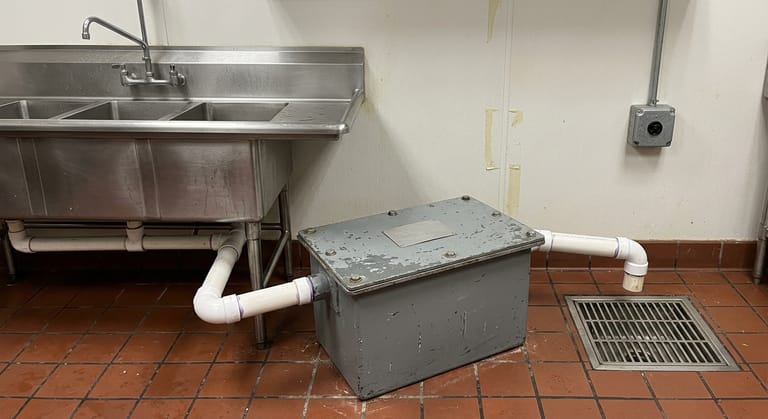
Flow rating in GPM paired with grease capacity in pounds
The IPC pairs, under the code's own headings:
| TOTAL FLOW-THROUGH RATING (gpm) | GREASE RETENTION CAPACITY (pounds) |
|---|---|
| 4 | 8 |
| 6 | 12 |
| 7 | 14 |
| 9 | 18 |
| 10 | 20 |
| 12 | 24 |
| 14 | 28 |
| 15 | 30 |
| 18 | 36 |
| 20 | 40 |
| 25 | 50 |
| 35 | 70 |
| 50 | 100 |
| 75 | 150 |
| 100 | 200 |
The ladder ends at 100 gpm. Above that rating the table gives arithmetic instead of rows: the pounds figure is the flow doubled, so 250 GPM sits with 500 pounds, 500 GPM with 1,000 and 750 GPM with 1,500. The steps jump too, so 40, 60 and 80 GPM have no row of their own.
A GPM figure is not the body's volume, nor peak fixture flow: it is a certified rating with an assumed drain time, and Schier's GB-1000-B sheet bases its flow rates on 2 minutes, which is why that arithmetic belongs on interceptor sizing. Jay R. Smith publishes the same ladder in its technical data.
The flow control fitting and its vent
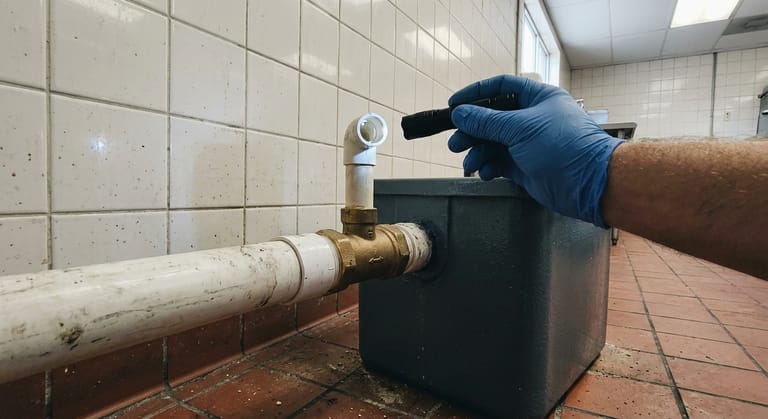
Rate-of-flow control is code, not an accessory: the Alabama Plumbing Code 2009, built on the 2009 IPC, requires at Section 1003.3.4.2 a device that keeps inflow from exceeding the rated flow. Zurn's guidance for its 10 to 15 GPM units calls the device required upstream, with three jobs: venting odors, regulating flow and an air cushion for separation.
Zurn describes the GT2700, a 4 inch no-hub unit supplied with flow control and rated at 75 GPM, as PDI certified. The fitting is not universal: Schier's GB-1000-B specification sheet notes that unit does not require one.
Venting applies to the whole family: IPC Section 1003.9 in the 2021 code requires that an interceptor not become air bound and be vented by a Chapter 9 method, and Section 1003.10 puts a two-way cleanout on the discharge line immediately downstream. All three sections are quoted on installation requirements. Point-of-use retrofits fail inspection on that pair; placement rules sit on under sink interceptors.
Talk to someone who opens these lids every week
Call (800) 555-0184Free to dial. Whoever answers pumps and services grease interceptors; ask for the registration number your city requires while you are on the call.Partner haulers and plumbers who work on food service drains- Partners who pump interceptors, not just unclog sinks
- Answered during the dinner rush
- Dialing costs nothing and books nothing
Automatic grease interceptor units and the adjacent standards
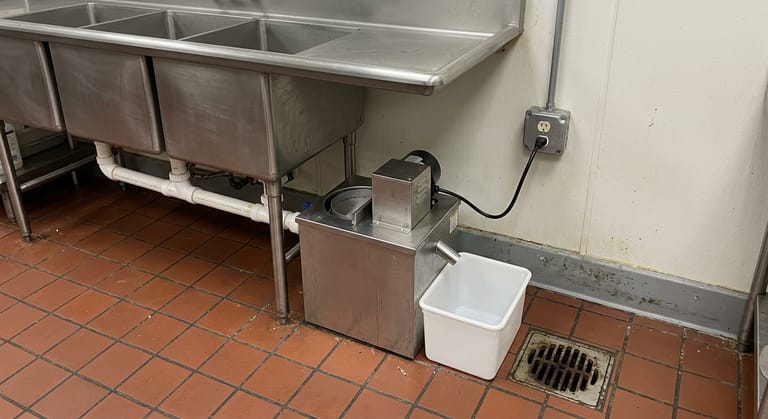
Buyers search for an automatic grease interceptor; the code files the powered class under its own name, automatic grease removal device. Section 1003.3.6 of the 2021 IPC requires that "such devices shall be located downstream of each fixture or multiple fixtures", and the rest of that sentence sends you to the manufacturer's instructions.
In the kitchen the unit serves the sink ahead of it, not a whole room, on the clearances and inlet fall the manufacturer's sheet sets. Kitchen staff empty the container and keep the log; the piping stays with the trade.
For sizing, Section 1003.3.5 points to ASME A112.14.3, A112.14.4, A112.14.6, CSA B481.3 or PDI-G101. A112.14.6, "FOG (Fats, Oils, and Greases) Disposal Systems," a 2010 edition reaffirmed in 2024, covers equipment that disposes of retained FOG internally rather than only holding it.
Thermaco's Big Dipper line is that class in practice, unlike the company's passive Little Dipper traps.
| Thermaco automatic model | Rated inlet flow |
|---|---|
| W-200-IS | 20 GPM (1.26 L/s) |
| W-250-IS | 25 GPM (1.58 L/s) |
| W-350-IS-T | 35 GPM |
| W-500-IS | 50 GPM (3.15 L/s) |
| W-750-IS-X | 75 GPM |
Thermaco also lists a W-1000-AST at 100 GPM as discontinued, so do not specify it.
Passive grease interceptor units
A passive grease interceptor has no motor, no skimmer and no controls: it separates on flow and holds what it catches until someone removes it. Thermaco rates its Little Dipper models the same way, LD-200 at 20 GPM, LD-250 at 25 GPM and LD-750 at 75 GPM. The trade-off is labor, which is why cleaning and how often it must happen matter more here.
Hydromechanical grease interceptor vs gravity interceptor
The split is the rating basis: certified flow in GPM with a paired pound figure here, liquid volume in gallons on gravity tanks, and the 2 pounds per GPM relationship does not carry across.
Size is not the divider. Schier's Great Basin line is listed by IAPMO to the hydromechanical standard and to CSA B481.1, and it runs far past point of use: the below-grade GB-1000-B is a Type D unit specified at "Interceptor flow rate shall be 200 GPM". Watch its pound figures, since the engineer specification reads "Interceptor grease capacity shall be 3,681 lbs." at 99.0% efficiency while the tank note on the same page gives 3,939 lbs.
| Great Basin model | Rated flow | Rated grease capacity |
|---|---|---|
| GB1 | 25 GPM | 57 lbs |
| GB-1500 | 100 / 200 GPM | 10,061 / 9,446 lbs |
Paired values are two ratings for one tank, the higher flow giving the lower capacity, so pull the model sheet. Canplas indexes Endura the same way; the other seven Great Basin models sit on Schier interceptors.
What a plan reviewer wants before approving one
A cafe in a leased space wants a point-of-use unit instead of cutting the slab, and reviewers accept one on conditions that repeat city to city: a certified listing to the standard the adopted edition names, rated flow covering the fixtures, flow control where the manufacturer calls for it, a vent path that keeps the body from going air bound, a two-way cleanout downstream. Over that sits the local sewer authority's FOG program, which can demand a bigger unit than the code does.
Two minutes with a flashlight settles most of it:
- Read the label: GPM rating, pound rating, certification mark.
- Look at the inlet: is a flow control fitting there, and is its vent clear rather than taped or painted over?
- Look downstream of the outlet for a two-way cleanout.
Past that list the work is a licensed trade's: repiping an inlet, adding flow control, correcting a vent, cutting in a cleanout, pulling the permit.
When the label rating covers the fixtures, the vent is open and a cleanout sits downstream, that kitchen needs a cleaning interval, not new equipment.
Talk to someone who opens these lids every week
Call (800) 555-0184Free to dial. Whoever answers pumps and services grease interceptors; ask for the registration number your city requires while you are on the call.Partner haulers and plumbers who work on food service drains- Partners who pump interceptors, not just unclog sinks
- Answered during the dinner rush
- Dialing costs nothing and books nothing