9 Grease Interceptor Requirements Inspectors Check
The short of it
- IPC Section 1003.3.1 requires every fixture with grease-laden waste in a food preparation area to drain to an interceptor.
- A flow control fitting keeps water at the rated flow, and IPC 1003.9 requires venting so nothing goes air bound.
- No food waste disposer may tie into the line, and additives that emulsify grease, chemical or enzyme, are barred as well.
- Downstream, the model code names only a two-way cleanout; a sampling box comes from your sewer authority instead.
- Reaching inside an in-ground tank is confined space work for a hauler, and cutting in a sample box is contractor work.
Grease interceptor requirements begin with IPC Section 1003.3.1: any fixture with grease-laden waste in a food preparation area must drain to an interceptor. Everything after that sentence is scattered across subsections, and the sampling point is often not in the plumbing code at all.
Below, the grease interceptor requirements run in the order an inspector walks them. Sizing math is on grease interceptor sizing, the order of the work on grease trap installation. When a walk-through turns up nothing where a fitting should be, (800) 555-0184 connects to a service partner covering the same jurisdiction.
Where grease interceptor requirements apply
IPC Section 1003.1 is a purpose clause, not a specification: the building has to stop harmful material, oil and grease first among them and sand alongside, from reaching the public sewer and the treatment plant. Nothing there tells a kitchen what to buy.
The requirement lands at Section 1003.3.1. As adopted in the MD Board of Plumbing, Plumbing Code 2024, a grease interceptor or an automatic grease removal device "shall be required to receive the drainage from fixtures and equipment with grease-laden waste located in food preparation areas." The venues named alongside cover everyone who cooks for other people: restaurants and bars, hotel kitchens, hospitals, school kitchens, factory cafeterias, clubs.
Equipment gets named too, and that half slips a kitchen's mind: pot sinks and prerinse sinks, soup kettles and similar devices, wok stations, any floor drain or sink a kettle is emptied into, automatic hood wash units, and dishwashers with no prerinse sink. The list is illustrative, not closed.
City programs stack their own triggers on the code. Phoenix states it flatly in its 2024 FOG manual: "All Food Service Establishments that prepare food on site in the City of Phoenix are required to have a grease interceptor to prevent FOG from discharging to the city sewer". The manual leans on City Code 28-12, whose own text requires an interceptor from a food service establishment when the Director determines one is necessary. The permit and category schemes in Los Angeles and San Francisco, alongside New York and Philadelphia, are compared on the restaurant grease interceptor page.
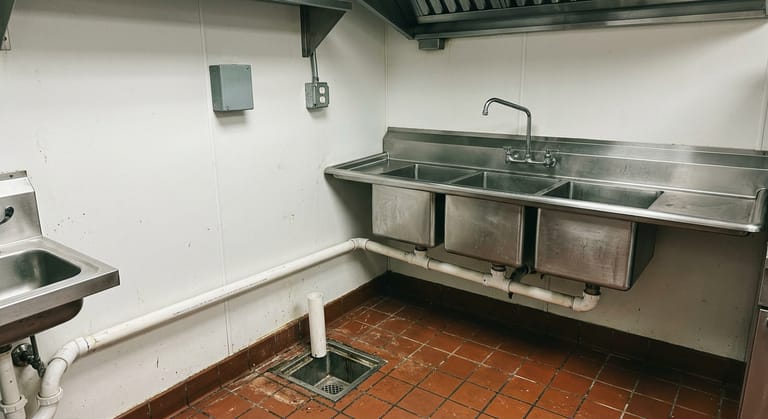
What the tank must never receive
Additives second. Section 1003.3.3 rules out any system feeding emulsifiers, chemicals or enzymes into an interceptor. The logic is mechanical: grease has to float to be skimmed off, and droplets small enough to travel simply move the deposit into the lateral. Microbial products that enhance aerobic bioremediation stay permitted.
Sanitary fixtures stay out. Under UPC Section 1014.3.2, scullery sinks, pot sinks, dishwashers and floor drains may discharge through a gravity unit; water closets and urinals may not.
Device class is often dictated locally. Phoenix approves hydromechanical units for up to four plumbing fixtures and requires gravity above four, or for any kitchen with a disposal unit or a dish machine. The classes are compared on hydromechanical units and gravity units.
Flow control device for grease interceptor inlets
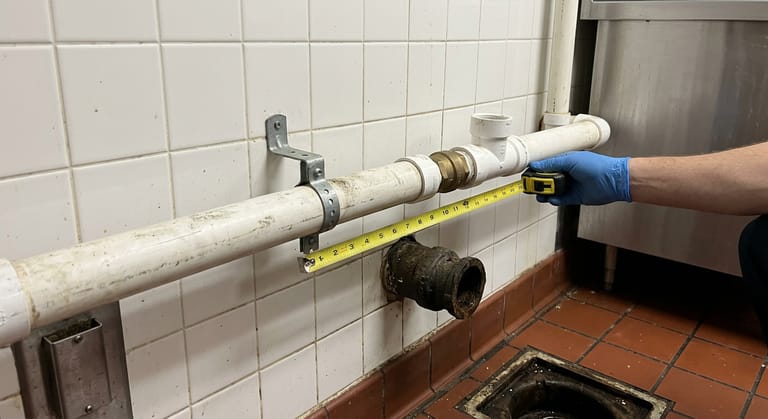
A rated interceptor holds its rating only at a controlled flow, hence the fitting ahead of it. Older IPC editions put it at Section 1003.3.4.2, visible in the Alabama Plumbing Code 2009: a unit gets "devices to control the rate of water flow", so nothing reaches it faster than its rating. The block was renumbered later, so that citation alone means little to a plan checker on IPC 2021.
The rating is a speed, not a bucket: gallons per minute, not tank gallons. Empty a full pot sink at once and water hits a 25 gpm unit faster than it can separate, so grease that should have risen goes over the baffle and out. The fitting meters that rush.
The rating itself comes from IPC 2021 Section 1003.3.5, which points sizing at ASME A112.14.3, ASME A112.14.4, ASME A112.14.6, CSA B481.3 or PDI-G101 and requires those devices to be installed per the manufacturer's instructions, so the manufacturer's sheet, not the code, is where the fitting's orientation and venting are set.
Grease interceptor venting and the air bound problem
Two duties sit in IPC Section 1003.9. One is a design duty, that the unit not "become air bound". The other is venting, and which method counts is left to Chapter 9.
The symptom is plain: trapped air has no way out, the tank stops taking flow as fast as the fixtures send it, and a sink drains slowly for no visible reason. Outdoor tanks fall under the same section, and which Chapter 9 method is acceptable belongs to the authority having jurisdiction. A venting diagram approved in one city gets red-lined in the next.
Talk to someone who opens these lids every week
Call (800) 555-0184Free to dial. Whoever answers pumps and services grease interceptors; ask for the registration number your city requires while you are on the call.Partner haulers and plumbers who work on food service drains- Partners who pump interceptors, not just unclog sinks
- Answered during the dinner rush
- Dialing costs nothing and books nothing
Baffles, compartments, covers and access
Los Angeles is reported to define a gravity unit by its parts (LAMC Sec. 64.00): a minimum total volume of 300 gallons, a minimum retention time of 30 minutes, baffles, two compartments, gravity separation, and a location remote from where food is handled. That is the local definition, not a national floor. Phoenix sets its own: minimum size 500 gallons, two man-ways on approved 500 gallon tanks, three on 750 gallon and larger.
Access is what a site plan quietly designs away. UPC Section 1014.3.4 asks that the unit sit where it can be worked on, "easily accessible for inspection, cleaning", with room for the equipment that pulls the intercepted grease out. In practice a hose has to reach the lid, and no dumpster pad or new parking bay can sit over a cover.
Downstream, one fitting is named outright and it is not optional. Section 1003.10 puts a "two-way cleanout" on the waste line just past every interceptor and separator.
Sample box for grease interceptor discharge
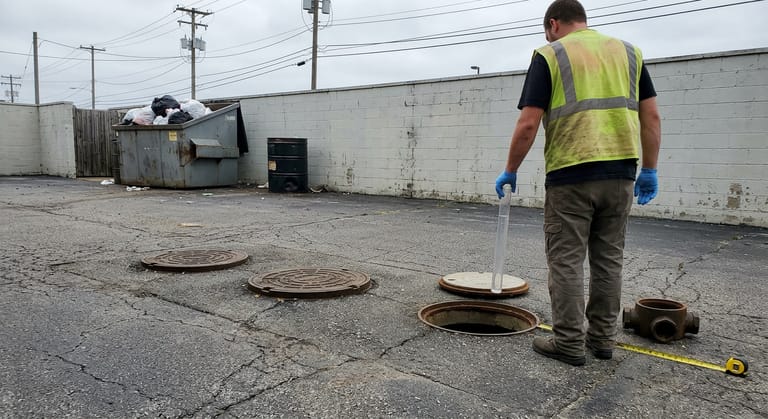
The sampling point is usually written by the sewer authority, not the plumbing code. What the model code names downstream of the tank is the two-way cleanout quoted above; some inspectors accept that casting, many will not. A separate port or box, where one is required, comes from that authority's pretreatment program, and the detail they accept varies by city. Ask the pretreatment section before concrete is poured.
If an inspector lifts the outdoor lid and asks where the sample point is, check two things first.
- Walk the discharge side from the outlet lid toward the property line, looking for a second, smaller lid or a cleanout casting. Sample boxes disappear under mulch and asphalt.
- Pull the permit set, the as-built and the service records behind your cleaning schedule. If a box or a cleanout is drawn, this is a locating problem, not an installation problem.
If there is nothing downstream of the outlet, the rest is contractor work: locating the line, excavating, cutting in the box, and producing a drawing the plan checker will sign. Silverbeck writes about this work rather than performing it, so ask whoever answers the number above whether they have set sampling boxes for your sewer authority.
What the grease interceptor detail drawing has to show
Phoenix requires plan review for every interceptor installed or replaced in the city (the manual sentence is quoted on the grease trap installation page), and the review verifies sizing, an approved model and that every grease bearing fixture is plumbed to the tank.
So the drawing carries each item above, checked against local grease interceptor requirements: fixtures routed in and fixtures kept out, the flow control fitting, baffle and compartment layout, cover and man-way locations, the vent, the cleanout, and the sampling point. Name the adopted edition in the title block too: the capacity table is Table 1003.3.5.1 in IPC 2021 and 1003.3.4.1 in 2006 through 2012 era editions.
Nine things an inspector physically checks
| Check | Where it comes from |
|---|---|
| Every grease bearing fixture drains to the tank | Phoenix plan review, 2024 manual |
| No food waste disposer tied into the line | IPC 1003.3.2 |
| Flow control fitting holding flow to the rated figure | IPC rate of flow controls, pre-2015 editions |
| Vent present, tank not air bound | IPC 1003.9 |
| Two-way cleanout immediately downstream | IPC 1003.10 |
| Sampling point where the local program requires one | Local pretreatment program (ask before pouring) |
| Covers and man-ways present and reachable | UPC 1014.3.4; Phoenix man-way counts |
| Fill level under the local threshold | Phoenix: above 25 percent of device capacity, 2024 manual; other cities on the cleaning frequency page |
| Records and manifests on site | Phoenix: 3 years at the facility, on request |
Walk your own installation against that table. The gap between what is in the ground and what grease interceptor requirements ask for usually surfaces in ten minutes.
Talk to someone who opens these lids every week
Call (800) 555-0184Free to dial. Whoever answers pumps and services grease interceptors; ask for the registration number your city requires while you are on the call.Partner haulers and plumbers who work on food service drains- Partners who pump interceptors, not just unclog sinks
- Answered during the dinner rush
- Dialing costs nothing and books nothing