Grease Trap Pumping, All 3 Layers Out in 6 Steps
The short of it
- Pumping empties all three layers, the grease cap, the liquid column and the settled solids, by vacuum truck.
- Inside Houston's city limits, every grease interceptor gets a full evacuation at least every 90 days unless a Notice of Waiver is approved.
- A manifest should accompany each pump-out, and Greensboro wants receipts submitted within 14 days of maintenance.
- Wastewater leaves with the load: Windsor Heights, Iowa ordinance 100.62 keeps it out of private sanitary and storm sewers.
- Nobody reaches into the tank, but finding the covers and the last manifest takes two minutes with covers closed.
Grease trap pumping empties all three layers, the grease cap, liquid column and settled sludge, by vacuum truck, and Houston puts 90 days at the outside for that full evacuation. Skimming the floating cap is a different transaction. Inside the incorporated city limits, the Houston Health Department's special waste generator guidance reaches every grease interceptor, and the way off that 90 day clock is an approved Notice of Waiver application.
Silverbeck publishes and runs no trucks: calling (800) 555-0184 reaches a partner company that sends the vacuum truck, empties the trap and issues the manifest.
Grease interceptor pumping means the in-ground vault
Grease interceptor pumping usually means the outdoor gravity unit, a concrete or fiberglass tank set below grade under manhole covers and sized in gallons of retained volume. The indoor hydromechanical trap beside a three-compartment sink is rated in gallons per minute of flow instead, and which one a kitchen has decides which truck shows up.
New York City turns that difference into arithmetic. Its sizing rule for gravity units, 15 RCNY § 19-11(a) as DEP publishes it, starts from the flow rating and directs that "such minimum flow rate in gallons per minute shall be multiplied by 3." Fifty gpm therefore lands on a 150 gallon minimum in that city, which is why a hauler pricing the visit asks for gallons, not for the gpm figure on an indoor unit.
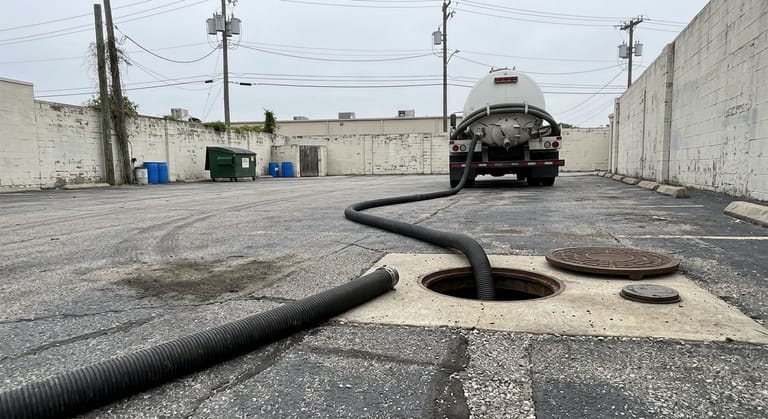
What a full pump-out takes out of the trap
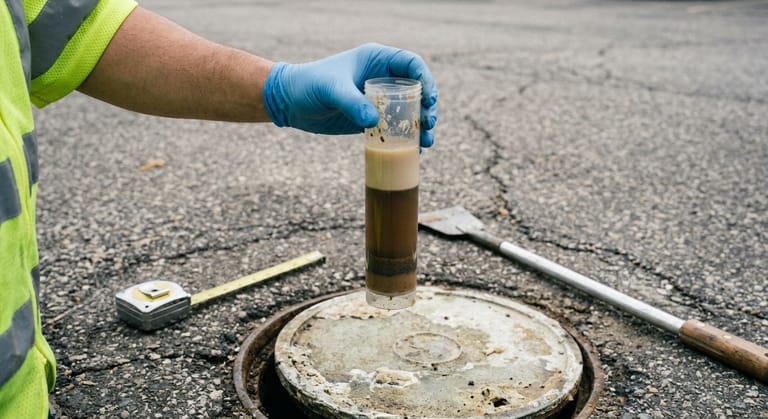
Three layers, not one. A floating cap of fats, oils and grease sits on top, a liquid column fills the middle, and settled solids occupy the bottom. A partial visit takes the cap and leaves the rest in place. Service intervals are set by the program that regulates the building, and procedure for the small point-of-use units under a sink belongs to grease trap cleaning, not here.
- Covers come off and the hauler reads cap and sludge depth before anything moves.
- The floating cap goes first, lifted out through the vacuum hose.
- Next comes the liquid column, drawn down the full depth of the tank.
- Settled solids come last and take the longest.
- With the trap empty, baffles and the inlet and outlet tees are inspected from the surface.
- The manifest is completed and a copy stays with the establishment.
All six steps happen at the covers, on equipment the kitchen does not own. The job from inside is simpler: hold the dish pit until the truck leaves, so the empty tank refills with rinse water, not a sink of hot fat.
Why the liquid does not go back in
Wastewater counts as part of the load, not as something to refill the tank with. Under ordinance 100.62 in Windsor Heights, Iowa, whatever leaves a grease interceptor or trap, water included, has to end up at a water reclamation facility or at another facility approved to take that waste, and putting it into a private sanitary sewer, a storm sewer or the city system is barred. One city, one ordinance, but note the reach: the liquid fraction, not only the cap on top.
Additives are not a shortcut either: New York City's 15 RCNY § 19-11(u) bars emulsifiers, enzymes, chemicals and microbial agents in grease interceptors outright, and what actually belongs in a service kit is a shorter list than the shelf suggests.
Where the load goes after the truck pulls away
A commercial kitchen puts out two grease streams and they leave on separate trucks. Fryer oil is the yellow stream: New York City, at 15 RCNY § 19-11(v)(1), narrows who may take it away to a carter licensed for trade waste removal by the Business Integrity Commission, and requires written proof of collection at each pickup. Trap contents are the brown stream, bound wherever the local ordinance sends them, and a fryer oil receipt does not stand in for a trap manifest.
Talk to someone who opens these lids every week
Call (800) 555-0184Free to dial. Whoever answers pumps and services grease interceptors; ask for the registration number your city requires while you are on the call.Partner haulers and plumbers who work on food service drains- Partners who pump interceptors, not just unclog sinks
- Answered during the dinner rush
- Dialing costs nothing and books nothing
The manifest is the chain of custody
Paperwork is what makes a pump-out provable months later. In the grease trap article for the City of Kaufman, Texas, a manifest accompanies each pump-out as the recordkeeping document, and the duty to log every separate collection and deposit on that form sits with generators, collectors and transporters alike. The restaurant is the generator on that list, so the record is not the hauler's problem alone. Retention periods and report contents by city sit in the table on the interval page.
A binder with the last four manifests answers an inspector in a minute; an empty one means rebuilding the record from old invoices.
The confined space rule behind a closed cover
Federal OSHA sets the definition at 29 CFR 1910.146(b), and it runs on three tests met together: room enough for a worker to get a body inside and do the assigned job, entry or exit that is limited or restricted, and a space "not designed for continuous employee occupancy." A buried vault under a manhole cover fits that description.
Whether a below-grade trap meets all three is the employer's determination, not a publisher's, and the same rule makes a space permit-required once its atmosphere is hazardous. The NIOSH Pocket Guide to Chemical Hazards lists "Sewer gas" among the synonyms for hydrogen sulfide, prints the OSHA permissible exposure limit as "C 20 ppm 50 ppm [10-minute maximum peak]" and puts the IDLH value at 100 ppm, which is not a safe working level.
Nobody climbs in and nobody reaches in. Not the manager, not a porter, not for a dropped phone or a lost strainer. When something goes through an open cover, close the cover and say so on the call.
Commercial grease trap pumping usually starts with a vault nobody has opened in a year
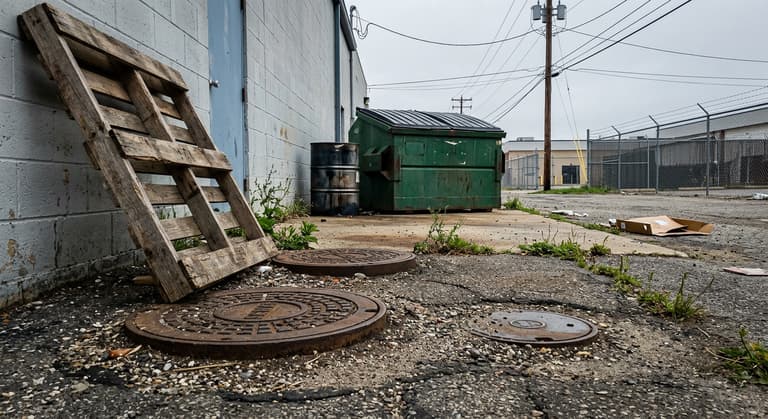
The usual version of this call is a restaurant that changed managers: nobody knows where the last manifest went, the covers sit under gravel or behind a dumpster pad, and the dish pit drains slowly by Saturday night. A trap in that state is not a routine stop, and saying so on the phone gets the right truck sent.
Two minutes of checking, no cover removed:
- Walk outside and find the covers. Note what is sitting on them and how close a truck can park.
- Open the compliance binder for the last manifest, the volume removed and the disposal location.
- Pull the trap size in gallons off the plumbing plan. Sizing explains what that number means.
- Run the dish pit at closing and watch the floor drains.
Costs turn on gallons, access and disposal, all three local. Figures live on grease trap cleaning cost, not on this page.
Grease trap pumping services near me, and what to say when you call
Proximity matters for two reasons that have nothing to do with map pins: the hose has to reach the covers from wherever a truck can legally park, and the load has to reach a facility approved to receive it.
Call (800) 555-0184 and lead with these when the line is answered:
- Type and location of the trap: in-ground outside, or the small unit inside under a sink.
- Size in gallons if the record shows it, or the gpm rating if that is all there is.
- The date on the last manifest, or a plain statement that no record exists.
- Parking distance to the covers, and anything sitting on top of them.
- Whether the restaurant drains are backing up right now, which turns a scheduled visit into an emergency call.
- What the city or sewer authority wants as proof, and by when.
If the binder already shows a recent pump-out and the drains run clean at close, there is nothing to call about yet.
Talk to someone who opens these lids every week
Call (800) 555-0184Free to dial. Whoever answers pumps and services grease interceptors; ask for the registration number your city requires while you are on the call.Partner haulers and plumbers who work on food service drains- Partners who pump interceptors, not just unclog sinks
- Answered during the dinner rush
- Dialing costs nothing and books nothing