Grease Trap Installation in 9 Steps, Permit First
The short of it
- Permit and plan review come first: Phoenix sends every interceptor installed or replaced through plan review before anything is bought.
- Phoenix draws the line at four fixtures; any disposal or dishwasher pushes the job to an underground gravity interceptor.
- No food waste disposer may discharge to the interceptor under IPC 1003.3.2, and that line bounces submittals.
- San Diego charges $264.25 for the first unit and $87.68 per additional unit, as of May 2026.
- Staff can open an indoor lid, but a buried unit is confined space work for an equipped hauler.
A grease trap installation runs in a fixed order: permit and plan review first, then a size the reviewer accepts, then placement, piping, venting, inspection and sign-off.
The City of Phoenix puts that first stage in writing. Its 2024 FOG manual for food service establishments states, "Per plumbing code all grease interceptors installed and replaced in the City of Phoenix must go through plan review." A trap bought before that review may not match the approval.
The installation of grease trap equipment, step by step
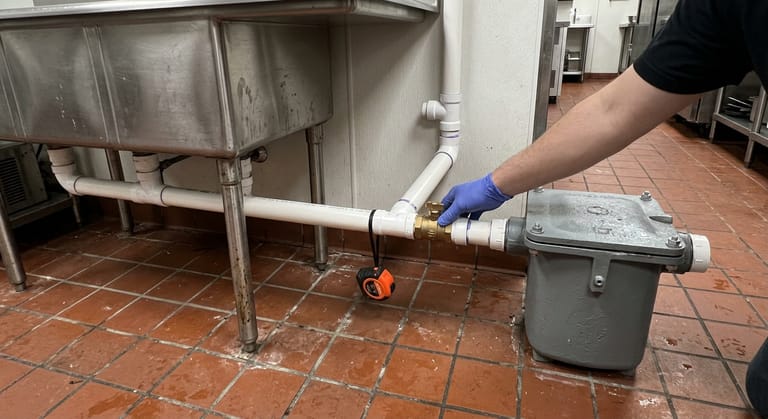
The first three stages are paperwork, and that is where projects stall.
- Plan review and permit. Phoenix sends a new trap through electronic plan review; a like for like hydromechanical replacement may go over the counter. The manual also requires a certificate of occupancy.
- A size the reviewer accepts. The method belongs to the adopted code, not the vendor: Phoenix checks sizing, an approved model, and that every grease bearing fixture is piped to the trap.
- Device type and listing. Hydromechanical units are tested and rated under PDI-G101, "Testing and Rating Procedure for Grease Interceptors," revised 2017, and under ASME A112.14.3/CSA B481.1.
- Location. The trap belongs close to the fixtures it serves, and UPC 1014.3.4 requires that a gravity unit stay open to inspection and pumping and within reach of the maintenance equipment that serves it. If a pump truck cannot reach the lid, the job has failed before the first cleaning.
- Excavation or interior placement. A buried trap needs a hole, bedding and a traffic rated cover where vehicles drive; an indoor box needs clearance to open its lid.
- Flow control fitting. The Alabama Plumbing Code 2009, an IPC 2009 adoption, requires a device that keeps water flow at or under the unit's rated flow.
- Venting. IPC 1003.9 requires the unit be designed so it cannot go air bound, and vented by one of the Chapter 9 methods.
- Connection, cleanout and sampling point. IPC 1003.10 puts a two-way cleanout on the discharge line immediately downstream of the unit. The outlet side is also where states write in their own language: the Louisiana Plumbing Code 2021 adds Section 1003.3.8, a state amendment with no counterpart in the model IPC, so that piping leaving an interceptor "shall be directly connected to the sanitary drainage system." Nothing indirect is left on that side of the tank, whatever the fixtures upstream are doing. A sampling point, where one is called for, is a local sewer program item rather than a plumbing code item.
- Inspection and sign-off. Cover inspection matters most on a buried trap, since nobody verifies piping already under dirt. Ask at submittal which stages the office wants to see.
The plan set is the real deliverable: a piping diagram showing every grease bearing fixture, the flow control fitting, the vent and the downstream cleanout. Full grease trap installation requirements, section by section, sit on the code requirements page. On a replacement, UPC 1014.3.7 sends the old tank out pumped and filled first.
When a correction needs a plumber on site instead of a note on the sheet, calling (800) 555-0184 puts a partner contractor on the job who can walk the kitchen and price the fix. Silverbeck publishes; the company that answers does the work.
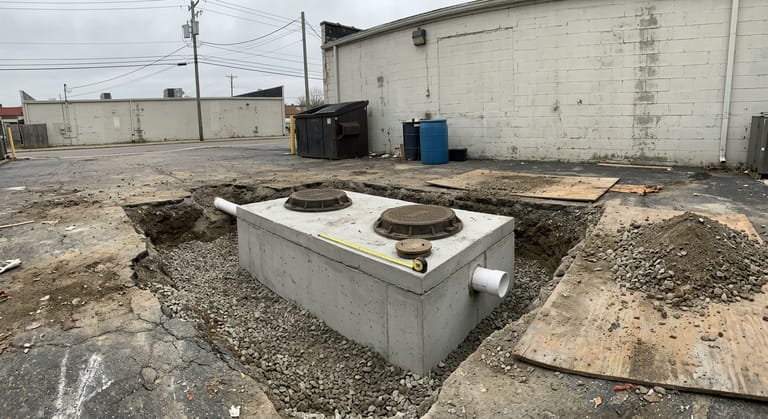
Grease trap interceptor installation splits into two different jobs
In conversation both are "the grease trap," but an indoor trap under a sink and a buried tank share almost nothing. Phoenix draws the line by fixture count; where each is the wrong answer is on the gravity interceptor page.
| Indoor hydromechanical unit | Underground gravity interceptor | |
|---|---|---|
| Phoenix trigger | Up to four fixtures, no disposal, no dishwasher | Above four fixtures, or any disposal or dishwasher |
| Product standard | PDI-G101 rating, ASME A112.14.3/CSA B481.1 | UPC 1014.3.3: the applicable Chapter 17 standard, or a design approved by the Authority Having Jurisdiction |
| Service access | Staff can open the lid | Confined space work for an equipped hauler, never for staff |
Under sink grease trap installation, and where it stops being allowed
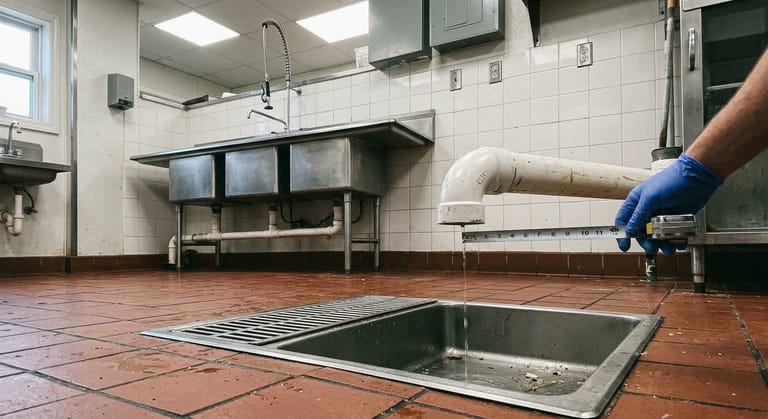
An indoor trap is a plumbing rough-in with two hard rules attached, and it sits inside the wider drainage picture covered on restaurant plumbing.
Rule one decides how a food fixture is allowed to meet the drain at all. Section 802.1.1 of the IPC 2021, carried unchanged into the Delaware Plumbing Code 2021, says such a fixture "shall discharge through an indirect waste pipe by means of an air gap." In a kitchen that is a visible vertical break: the waste line stops above a floor sink, water falls through open air, and a backed up sewer line has no path into a fixture that food touches. Section 802.1.7 eases that one notch for warewashing sinks outside dwelling units, where an air break is accepted instead of a full air gap.
The second rule kills more submittals: IPC 1003.3.2 keeps a food waste disposer off the interceptor line. So the three compartment sink and the prerinse sink can feed the trap; the grinder cannot. Clearance and pump-out access are on the under sink interceptor page.
Talk to someone who opens these lids every week
Call (800) 555-0184Free to dial. Whoever answers pumps and services grease interceptors; ask for the registration number your city requires while you are on the call.Partner haulers and plumbers who work on food service drains- Partners who pump interceptors, not just unclog sinks
- Answered during the dinner rush
- Dialing costs nothing and books nothing
The size a plan reviewer signs
How big the trap has to be is where a submittal clears or bounces. UPC 1014.3.6 takes the volume from its table by total drainage fixture units, and any fixture with no DFU value adds its flow rate times 30 minutes of retention. The UPC fixture-unit table and the IPC flow ratings are compared row by row on the interceptor sizing page.
Phoenix runs its own arithmetic instead: drainage fixture units times 3 gpm, times 17 minutes with a disposal or 12 without, which puts 12 DFUs at 432 gallons. The manual sets a floor under that result: "The minimum size allowed in the City of Phoenix is 500 gallons." The formula is a city program, not a national rule, and the IPC capacity table is numbered 1003.3.5.1 in 2021 but 1003.3.4.1 before 2015, so a section number alone never identifies a rule.
Grease trap/interceptor installation on the permit form
Fee schedules often bill the trap as one line whatever its size: San Diego lists it as "Grease Trap / Interceptor" in its permit fee bulletin, so gallon capacity does not move that number.
Who is allowed to do the work
Licensing is set by the state or local jurisdiction, not by the model plumbing code, so the counter reviewing your drawing also says who may pull the permit. Hauling grease away afterward takes a separate registration.
Los Angeles adds a second permit on top of the plumbing one. Under LAMC Sec. 64.30, food service establishments that generate grease waste must obtain an Industrial Wastewater Permit and must install and maintain an approved, adequately sized, remotely located and readily accessible gravity grease interceptor unless the Director grants a conditional waiver.
When the permit is not getting signed
Corrections cluster in the same few places, and you can check most of them yourself with the plan set open.
- Does the diagram show every grease bearing fixture routed to the trap, floor sinks and mop sink included?
- Is a food waste disposer drawn discharging into the trap? Under IPC 1003.3.2 that draws a correction, not an approval.
- Is the model approved for your jurisdiction, with its rating on the sheet?
- Are the flow control fitting, the vent and the two-way cleanout drawn, not just mentioned?
- Does the stated size come from your city's method, with the calculation shown?
Review itself carries no downtime, so submit early and keep serving. How often the trap needs cleaning once it runs is on the interval your city sets.
Grease trap installation near me, and what to ask the company that answers
A local search mixes installers, haulers and general plumbers, and only some of them handle permitted work. Four questions sort them out quickly:
- Whose license goes on the permit application, and does the number quoted already carry plan review?
- Which unit do they intend to set, and has your jurisdiction approved that model?
- On a replacement, who empties and fills the old tank, and at what point in the schedule?
- Which documents land in your facility file once the job closes?
A grease trap installation is one of the few plumbing jobs where the paperwork outlives the labor by years. Get the plan set right and the rest is digging.
Talk to someone who opens these lids every week
Call (800) 555-0184Free to dial. Whoever answers pumps and services grease interceptors; ask for the registration number your city requires while you are on the call.Partner haulers and plumbers who work on food service drains- Partners who pump interceptors, not just unclog sinks
- Answered during the dinner rush
- Dialing costs nothing and books nothing