Grease Trap Installation Cost Has 8 Lines, Not 1
The short of it
- No national average price for grease trap installation exists; the only dated public figure here is a city permit fee.
- San Diego bills $264.25 for the first unit as of May 2026, and gallon capacity does not change that.
- An installed cost stacks eight lines, from excavation and backfill through venting, sample port and permit.
- Five vendors bid one Texas cleaning scope between $0.20 and $1.95 per gallon, a roughly tenfold spread.
- A one-line estimate compares to nothing, so check whether it names the unit, permit, spoil, surface, cleanout and old tank.
There is no national grease trap installation cost, because only one line on a real estimate carries a published price, and that line is the permit.
Price aggregators cover water heaters and driveways, not commercial food service pretreatment.
The one dated public figure this page can stand behind is a San Diego permit fee, $264.25 for the first unit as of May 2026, a small fraction of the job. To get the rest of the cost priced for your own building, a call to (800) 555-0184 reaches an independent partner service company that can walk the site and quote the lines below.
The one published number here is a city permit fee
The City of San Diego Development Services Department publishes plumbing permit fees in Information Bulletin 103, which bills the device under a single line, printed as "Grease Trap / Interceptor".
| San Diego permit line, as of May 2026 | Amount |
|---|---|
| Grease trap or interceptor, first unit | $264.25 |
| Each additional unit on the same permit | $87.68 |
| Mapping fee (general, not grease specific) | $12.16 |
The bulletin sets no separate minimum plumbing permit fee, and plan check and inspection charges can sit on top. Because traps and gravity interceptors share that one line, capacity does not change the permit cost in San Diego: a 500 gallon unit and a 3,000 gallon unit hit the same $264.25.
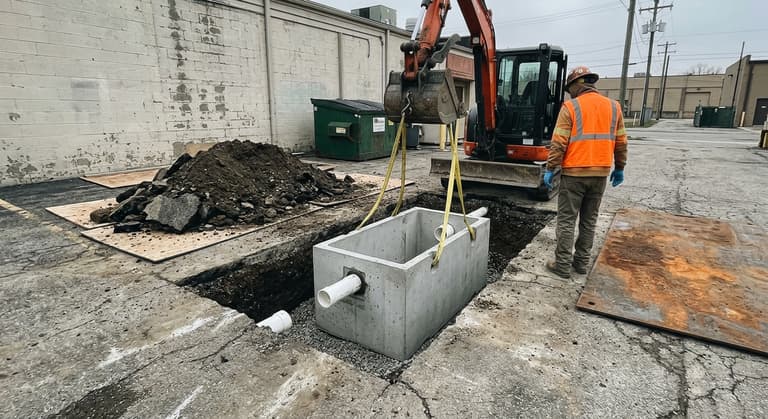
What a commercial grease trap installation cost includes, line by line
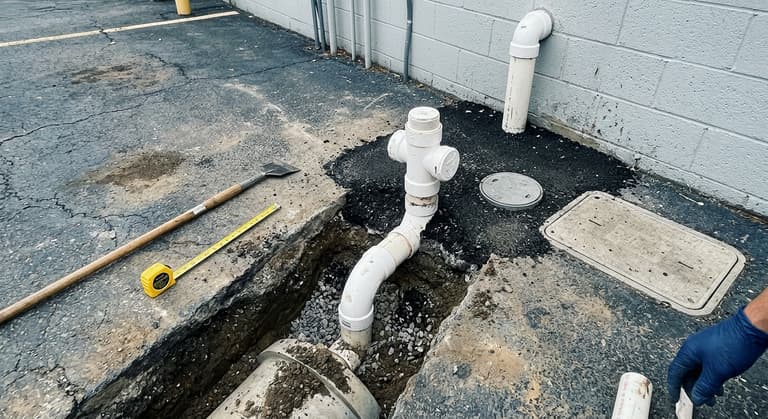
An installed cost is a stack of eight lines, each one set by something different.
| Line on the estimate | What sets the price |
|---|---|
| 1. The interceptor itself | Capacity, device class, material, certification |
| 2. Excavation and spoil removal | Depth, soil, how far the spoil travels |
| 3. Bedding and backfill | Base material, compaction, groundwater |
| 4. Surface restoration | Asphalt, slab or turf |
| 5. Plumbing connection | Run length, inlet and outlet inverts, downstream cleanout |
| 6. Vent and flow control | Venting path and, on a hydromechanical unit, the flow control fitting |
| 7. Sample port or monitoring access | Whether the local pretreatment program requires one |
| 8. Permit and inspection | The fee schedule and the number of inspections |
Line 1 is not a shopping decision. The 2021 Uniform Plumbing Code sizes commercial kitchen gravity units on drainage fixture units through Table 1014.3.6, which runs from 8 DFUs at 500 gallons up to 2,640 DFUs at 15,000 gallons. The method belongs on the sizing page.
Line 5 carries a piece quotes often leave out: IPC 1003.10 requires a two-way cleanout immediately downstream of the interceptor. Line 6 carries two: venting so the unit cannot go air bound, and on a hydromechanical unit a flow control fitting that holds inflow to the rated figure.
UPC 1014.3.4 also requires the unit to stay reachable for inspection and cleaning, so the cheapest corner of the lot is not always an allowed corner. All three code sections are quoted in full on the installation requirements page.
How much does a grease interceptor cost, and why no list price is printed here
No document behind this page publishes equipment prices, so a specific grease interceptor cost cannot be given here honestly, but what the price tag is built from can be. Device class comes first: a point of use hydromechanical unit and an in-ground gravity tank are different products at different scales.
Certification comes next. Hydromechanical units are tested and rated under PDI-G101, the Testing and Rating Procedure for Grease Interceptors, revised 2017, and under ASME A112.14.3/CSA B481.1, currently the 2022 edition with a December 2022 errata. Use of the PDI standard is voluntary in itself and becomes binding only where a code adopts it.
A manufacturer's grease interceptor price list is a starting point and nothing more. It excludes freight, the set, and everything below grade.
Talk to someone who opens these lids every week
Call (800) 555-0184Free to dial. Whoever answers pumps and services grease interceptors; ask for the registration number your city requires while you are on the call.Partner haulers and plumbers who work on food service drains- Partners who pump interceptors, not just unclog sinks
- Answered during the dinner rush
- Dialing costs nothing and books nothing
What moves grease interceptor installation cost the most
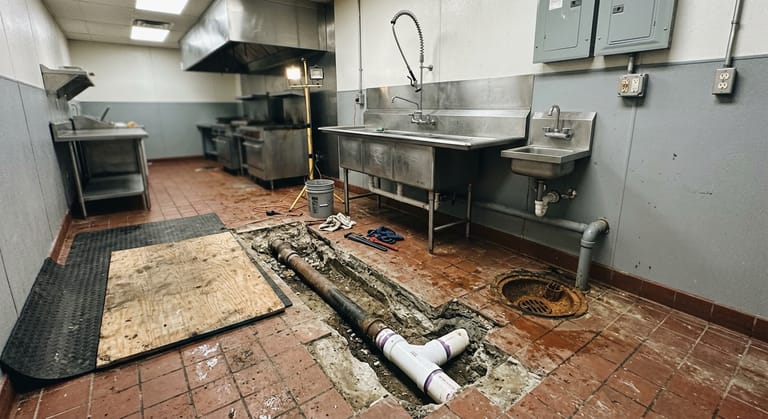
Three things move the cost more than the tank does.
Outside against inside. An in-ground unit in a parking area buys excavation, a traffic rating and pavement repair. A unit under a sink buys none of those.
Depth and access. A tank an excavator can reach in one pass is one job. The same tank down a shared alley or under a live utility corridor is another.
Live kitchen against new construction. In an operating restaurant the cost picks up night work, temporary drainage and a service line back before the lunch shift. On new work the trench is open anyway.
One item lands late, as a change order: the old unit. UPC 1014.3.7 requires an abandoned interceptor to be pumped and filled like an abandoned sewer, and that section is quoted on the installation page.
1500 gallon grease interceptor cost, and why the question starts in the wrong place
A 1500 gallon grease interceptor cost question points at a code output rather than a product tier. In UPC Table 1014.3.6, 172 drainage fixture units land at 1,500 gallons and 216 land at 2,000 gallons.
No source behind this page publishes a 1500 gallon grease interceptor price, and stitching one together from two unrelated pages would invent a number rather than report one. The same holds for a 2000 gallon grease interceptor price: the tank is the constant, and the hole is the variable.
Five bidders, one scope, a tenfold spread
The clearest public evidence that one number means nothing is a bid tabulation. IDEA Public Schools, a Texas charter school network, published a 2022-23 purchasing-year bid tab for IFB #05-IFB-CNP-2223, grease trap cleaning services. Five vendors priced the same haul and disposal line from $0.20 to $1.95 per gallon; the full sheet is on the cleaning cost page. Same buyer, same written specification, roughly a tenfold gap.
That solicitation covers cleaning rather than installation, and institutional volume pricing sits below what one restaurant is quoted. Still, if identical scope spreads tenfold inside one state, an installed cost you found online, for another building in another city, is not a budget.
Read the estimate in two minutes, then call
The estimate that should worry a restaurant operator is the one-line estimate: "Install grease interceptor, $X." It is not comparable to anything. Spend two minutes with the paper before you call anyone.
- Does it name the unit: make, model, capacity, device class?
- Who pulls the permit, and is the fee included or billed at cost?
- Where does the spoil go, and who pays to haul it?
- What happens to the surface, restored to what condition?
- Does it cover the connection, the vent and the downstream two-way cleanout?
- What happens to the old interceptor, including pumping and filling if abandoned?
A quote answering all six can be set beside another that does. One missing four of them compares to nothing, and those four are where change orders live.
Silverbeck publishes and researches; it digs nothing, installs nothing, pumps nothing. Calling (800) 555-0184 reaches an independent partner service company that can walk the site, size the unit, and put the eight lines of a grease trap installation cost on paper.
If you are still working out what the code requires, start with the sizing table and the installation process.