Restaurant Grease Interceptor Rules in 4 Cities
The short of it
- A grease interceptor is required by the fixtures in a food preparation area, not by seat count or menu.
- Dishwashers land on that required list only where no prerinse sink stands ahead of them.
- Sizing follows the code family your state adopted, gallons per minute under the IPC and drainage fixture units under the UPC.
- New York City sets cleaning by fill, capping grease and solids at 25% of the designed total liquid depth.
- Opening a buried tank is confined space work for an equipped hauler, while the stamped calculation belongs to a licensed plumber.
A restaurant grease interceptor is required wherever fixtures in a food preparation area send grease-laden waste to the drain, and the trigger is the fixture list, not the seat count. Maryland publishes its adoption of the International Plumbing Code as the MD Board of Plumbing, Plumbing Code 2024, and Section 1003.3.1 there sets the test at the drain itself: a grease interceptor or automatic grease removal device has to take "the drainage from fixtures and equipment with grease-laden waste located in food preparation areas." Restaurants and bars are named in that section, and so are clubs, hotel and school kitchens, hospitals and factory cafeterias, but those examples arrive with the words "such as," which leaves the list open rather than closed.
In a working kitchen the question reads as a walk from each drain back to the fixture above it. Braising pans rinsed off in the pot sink count. The prerinse spray station counts. The mop sink, the hand sinks and the ice machine usually do not. A 40 seat cafe that fries and braises can trip the requirement while a 200 seat room plating cold food may not, which is why a plan reviewer asks for a fixture schedule instead of a picture of the dining room.
A call to (800) 555-0184 reaches a partner company serving restaurants nearby, which can inspect the unit already in place and report its rating and condition. Silverbeck publishes and quotes nothing; the company that answers does.
Which fixtures feed a restaurant grease interceptor
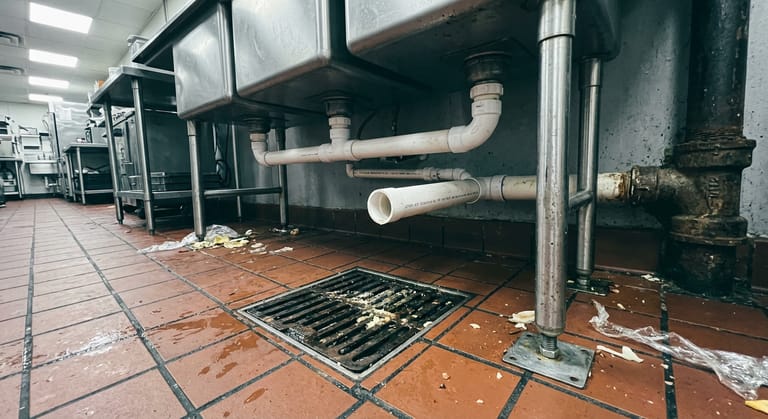
Section 1003.3.1 does not stop at the general rule. It enumerates the drains that have to run through the unit: pot sinks and prerinse sinks, soup kettles and similar vessels, wok stations, any floor drain or sink that kettles get emptied into, and automatic hood wash units. Dishwashers close the enumeration, but only those "without prerinse sinks."
That last clause decides more dish pits than any other line in the section. A machine fed straight off the dish table sits on the required list; the same machine with a spray station ahead of it does not, and the fixture schedule has to show that station for a reviewer to accept the distinction. Pull the prerinse sink out in a renovation and the dishwasher changes category with it.
The section fences the unit off in the other direction too. Nothing but fixtures and equipment capable of putting fats, oils or grease down the drain may be tied into it, so restroom drains, hand sinks and floor drains away from the cook line stay off that branch. The point is dilution: a tank sized for kitchen flow loses its retention time once clean water starts pushing through it. Start with trap versus interceptor if the two device families blur.
One further provision catches operators out during a remodel. In the Louisiana Plumbing Code 2021 adoption of IPC 2021, 1003.3.2 bars a food waste disposer from discharging to the interceptor, and the sentence itself is quoted on the installation requirements page.
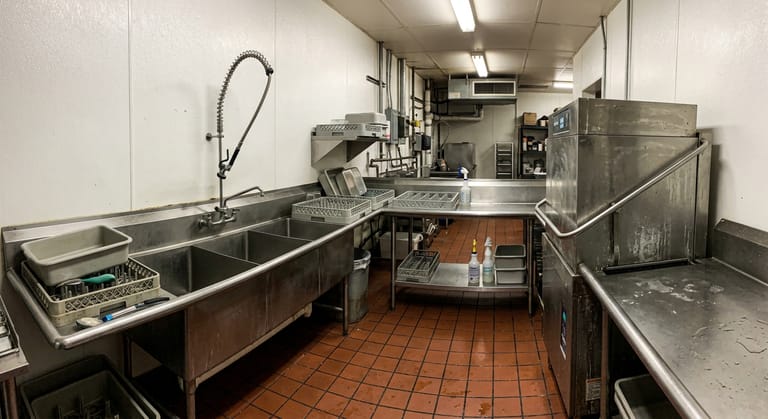
Sizing a grease interceptor for restaurant kitchens starts with fixtures
Under the model codes nobody sizes a restaurant grease interceptor by seat count or by menu; the method depends on which code family your state adopted, and Louisiana's headcount amendment below is the exception.
Under the IPC, Section 1003.3.5 of the 2021 edition sends sizing to ASME A112.14.3, A112.14.4 or A112.14.6, CSA B481.3 or PDI-G101, plus the manufacturer's instructions. The output is a flow-through rating in gallons per minute, and the capacity table pairs each rating with pounds of retention at exactly double it.
Under the UPC, buried units are sized by drainage fixture units instead. Section 1014.3 of the Hawaii Plumbing Code 2021 takes the volume from Table 1014.3.6 on a 30 minute retention basis.
Where meals served enters the math
Louisiana is the exception flagged above. Its amendment at Section 1003.2.1 of the 2021 code drives capacity off headcount rather than off the fixture schedule, taking the peak number of people served in the busiest meal period as the input. The arithmetic, and the multipliers that follow it, are worked through on the sizing page.
Interior grease interceptor or an in-ground vault outside
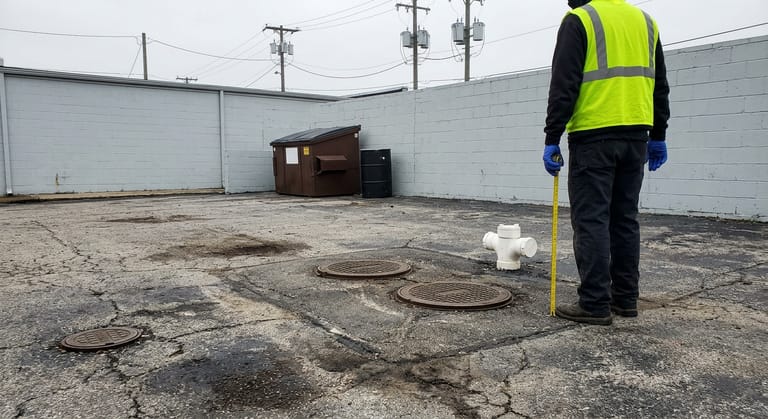
An interior grease interceptor is a hydromechanical unit under or beside the fixtures it serves. IPC 1003.3.6 requires an automatic device to sit downstream of each fixture or fixture group, in accordance with the manufacturer's instructions. The outdoor alternative is a gravity interceptor, a buried multi-compartment tank that UPC 1014.3.4 requires to stay reachable for inspection and pumping, with the access rule quoted on the installation requirements page. Los Angeles goes further and writes its own definition of a gravity unit into LAMC Sec. 64.00, with baffles, at least two compartments, gravity separation and a location away from where food is handled; Sec. 64.30 requires one unless the Director grants a conditional waiver. The full six-axis comparison is on the trap versus interceptor page.
| Question | Interior point-of-use unit | Exterior in-ground tank |
|---|---|---|
| Sits | downstream of the fixture or group | outside, away from food handling |
| Serviced | through the lid, indoors | by vacuum truck, as confined-space work |
Two IPC rules follow the tank wherever it lands: Section 1003.9 requires venting by a Chapter 9 method and a design that cannot become air bound, and Section 1003.10 requires a two-way cleanout immediately downstream of every interceptor and separator. Both are cheaper on the drawing than after the pour.
Talk to someone who opens these lids every week
Call (800) 555-0184Free to dial. Whoever answers pumps and services grease interceptors; ask for the registration number your city requires while you are on the call.Partner haulers and plumbers who work on food service drains- Partners who pump interceptors, not just unclog sinks
- Answered during the dinner rush
- Dialing costs nothing and books nothing
What a commercial kitchen grease interceptor has to satisfy in four cities
The code is the floor; each city program builds on it.
| City program | What it asks of a food service establishment | Where it is written |
|---|---|---|
| New York City DEP | Installation by a NYC Licensed Master Plumber; 90 percent average removal; retention pounds at twice the gpm figure; gravity volume at least that figure times 3 | 15 RCNY 19-11 (a), (e), (f) |
| Philadelphia Water Department | An approved unit on the pot sink, dishwashing sink, meat preparation sink and most can washing equipment; a single sink in a small restaurant starts at 20 gpm and 40 pounds; nearby fixtures in one room may share a unit | Pretreatment Guidelines, 2013 |
| Los Angeles | An Industrial Wastewater Permit, then an approved gravity interceptor unless the Director waives it, plus Best Management Practices | LAMC Sec. 64.30 and Sec. 64.00 |
| San Francisco (SFPUC) | Grease capturing equipment kept maintained and serviced, with maintenance logs, at "Restaurants and other food service establishments that cook food"; the specific duties follow one of three FOG Discharger Categories | Public Works Code Art. 4.1, Sec. 140, 140.3, 140.5 |
New York sets maintenance by fill, not by calendar: accumulated fat, oil, grease and solids may not pass 25% of the total liquid depth the unit was designed to hold under 15 RCNY § 19-11, quoted in full on how often the tank has to be emptied, which turns that standard into an interval. In practice that means a kitchen cannot answer an inspector with a quarterly invoice alone; somebody has to know how deep the layer sits between visits.
Who signs off before a commercial grease interceptor is approved
Three desks, and they speak to each other less than operators assume.
- The plan reviewer wants drawings, a fixture schedule and a sizing calculation that names its method.
- The plumbing inspector checks the unit, its access, its vent and the cleanout downstream. In New York City, the DEP rule requires a Licensed Master Plumber.
- The pretreatment program issues the permit or discharger category, sets the Best Management Practices and later asks for records.
Every restaurant grease interceptor approval turns on paper, and the document that stalls a kitchen build belongs to that third desk. Philadelphia's PWD Regulations put it at Section 502.7, which requires a Pretreatment Facilities Report with detailed plans and detailed operating procedures, accepted by the City before the facility is built or operated. Operating procedures, not just drawings.
If that report is what holds up your opening, the same line, (800) 555-0184, reaches a partner plumber who prepares the stamped sizing calculation it needs.
A licensed plumber owns the stamped calculation, the vent and the connection; a hauler owns pumping the tank and the manifest showing where the load went.
Before you shop for a grease interceptor for sale
Settle the required rating first, because a listing that looks like a bargain is usually the wrong unit. The gpm figure is a certified flow rate, not a tank size.
Flow control is not decoration: pre-2015 IPC editions, at Section 1003.3.4.2, require a fitting that holds inflow to the rated figure, and both the wording and its renumbering sit on the installation requirements page.
Secondhand tanks raise approval before price. UPC 1014.3.3 lets a gravity unit be built to the Chapter 17 standard or to a design the authority approves, as quoted on the gravity interceptor page, so an unlabeled used tank is a question for the local authority. Labels and model families are covered under interceptor brands.
Before buying anything, (800) 555-0184 reaches a partner plumber who can confirm the rating your city will accept for a restaurant grease interceptor.