Grease Interceptor vs Grease Trap, 6 Differences
The short of it
- The 2021 IPC and 2021 UPC have no device called a grease trap, and both say interceptor instead.
- A point of use unit is rated in gpm with a pounds figure, while a buried tank is measured in gallons.
- Louisiana's amendment to Section 1003.2.1 sets two floors, 125 gallons below the static water level and 20 gpm of approved flow; the authority picks the device, not the kitchen word.
- A notice mismatch is usually vocabulary, and four checks show whether the box inside or a buried tank is meant.
- Never open or enter a buried interceptor, because that is confined space work, and pumping or replacement is licensed.
Grease interceptor vs grease trap is a split in vocabulary, not in machines. Current model plumbing codes list no device by that name: the 2021 IPC and the 2021 UPC both write interceptor.
Kitchens call the box beside the three-compartment sink a trap and the tank out back an interceptor; inspectors call both. What splits them is rating, service, interval and licensing.
Which word the plumbing code actually uses
The IPC never uses trap. Maryland adopted the requirement as Section 1003.3.1, MD Board of Plumbing, Plumbing Code 2024: "A grease interceptor or automatic grease removal device shall be required to receive the drainage from fixtures and equipment with grease-laden waste located in food preparation areas."
Restaurants, hotel kitchens, hospitals, school kitchens, bars, factory cafeterias and clubs follow the words such as, so the roster is not closed.
The fixture list runs pot sinks, prerinse sinks, wok stations, the floor drains and sinks kettles empty into, automatic hood wash units, and "dishwashers without prerinse sinks." Put a prerinse sink ahead of the machine and the dishwasher is not the fixture named.
The UPC agrees. Hawaii's adopted Section 1014.3 covers the design, testing, construction and installation of "commercial kitchen gravity grease interceptors."
Where the word trap survives in code
In older adopted editions. The Alabama Plumbing Code 2009 numbers the capacity table 1003.3.4.1 under the old title grease trap capacity, while the 2021 IPC numbers that table 1003.3.5.1. Jurisdictions on pre-2015 editions keep the old number, so a section number without its edition year identifies nothing.
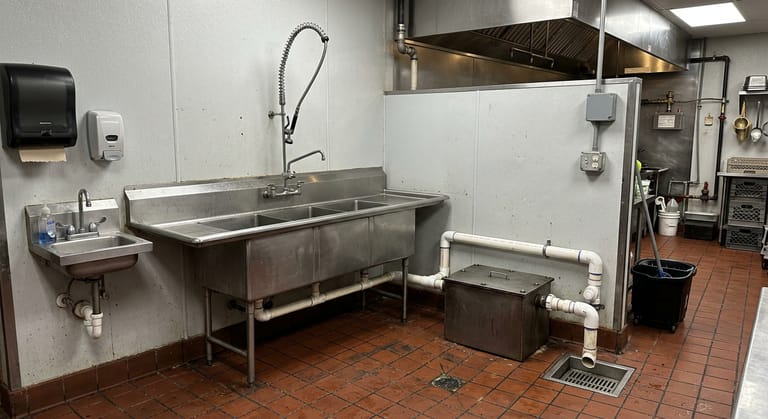
Difference between grease trap and grease interceptor, axis by axis
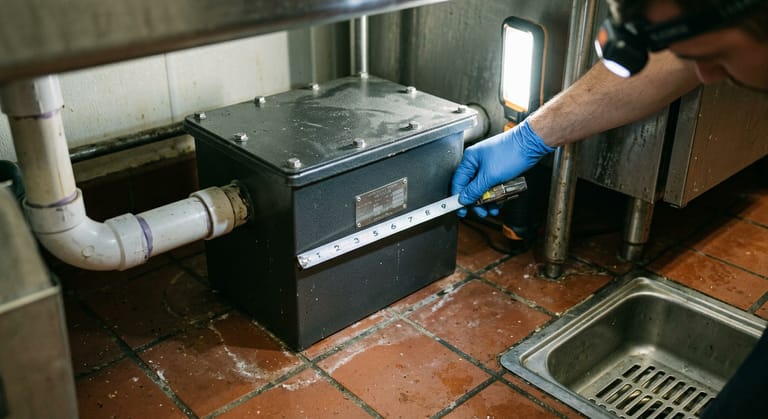
| Axis | Point of use unit (kitchens say trap) | In-ground gravity interceptor |
|---|---|---|
| Placement | At the fixture, indoors | Outside or in a vault, on the drain line |
| Rated by | gpm plus pounds, IPC Table 1003.3.5.1 (2021) | Gallons, UPC Table 1014.3.6 |
| Sized from | Fixture flow, IPC 1003.3.5 | Fixture units, UPC 1014.3.6 |
| Serviced by | Cleaned out on site | Vacuum truck, confined space work for an equipped hauler |
| Interval | Local FOG program | Local FOG program |
| Installed by | Licensed plumber, per manufacturer instructions | Plumber plus excavation, design the authority accepts |
Neither interval comes from model code. Across those six rows the split is point of use versus in ground.
A gpm rating is not a tank size
The IPC capacity table pairs gpm with retention in pounds, exactly twice the gpm figure in every listed row, from 4 gpm and 8 pounds to 100 gpm and 200 pounds; above 100 gpm the footnote doubles the rating.
Gravity units count gallons: UPC Table 1014.3.6 runs from 8 drainage fixture units and a 500 gallon tank to 2,640 DFUs at 15,000 gallons, rows worth checking against the printed table.
Grease separator vs grease interceptor, and what separator covers
Separator is the family word, and IPC Chapter 10 is titled Traps, Interceptors and Separators. Louisiana's adopted Section 1003.1 opens at that width, requiring interceptors and separators "to prevent the discharge of oil, grease, sand and other substances harmful or hazardous to the public sewer ...", the same sentence naming the private sewage system and the sewage treatment plant and its processes. Only at food preparation areas does it narrow to one member.
A third class exists. ASME publishes A112.14.6, "FOG (Fats, Oils, and Greases) Disposal Systems", built to pull FOG from the effluent, hold what it separates, then dispose of it internally by cutting mass and volume, wording quoted on the interceptor overview. A plain unit separates and holds only.
Talk to someone who opens these lids every week
Call (800) 555-0184Free to dial. Whoever answers pumps and services grease interceptors; ask for the registration number your city requires while you are on the call.Partner haulers and plumbers who work on food service drains- Partners who pump interceptors, not just unclog sinks
- Answered during the dinner rush
- Dialing costs nothing and books nothing
Point of use grease interceptor, the unit under the sink
A point of use grease interceptor is the hydromechanical unit at the fixture, rated by certified flow rate rather than tank gallons: 4 gpm with 8 pounds, 25 with 50, 50 with 100, the two to one ratio of the IPC table. Kitchens call these traps, covered on under sink models.
PDI-G101, "Testing and Rating Procedure for Grease Interceptors," revised 2017 rates as well as tests: independent laboratories run it, each unit tested gets a certificate and seal, and it is voluntary until a code adopts it. IPC 2021 Section 1003.3.5 also names ASME A112.14.3, which ASME's catalog currently lists as A112.14.3/CSA B481.1, "Hydromechanical Grease Interceptors (w/ 12/22 Errata)," 2022 edition; the edition a jurisdiction actually enforces may be older.
Jay R. Smith's fixture-volume procedure turns a 48 by 24 by 12 inch sink into about 44.9 gpm over a one minute drainage period, arithmetic on sizing.
When the jurisdiction requires a tank instead
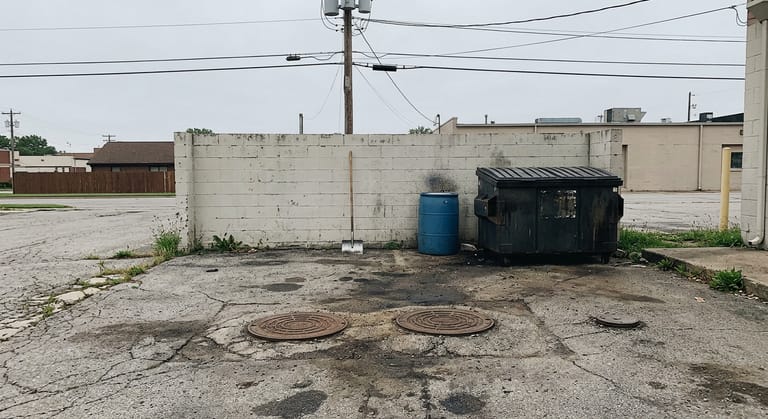
The authority having jurisdiction and the local FOG program decide, unless a state amendment settles it. Louisiana's amendment to Section 1003.2.1 drives capacity off head count, the maximum persons served during the largest meal period, floors that at 125 gallons below the static water level, adds at least 2 1/2 gallons per person above 50 persons served, and sets a floor of 20 gallons per minute on approved rate of flow. Gallons and gpm both, so there the amended text, not the kitchen word, decides; sizing reproduces it in full. That is a state amendment; model IPC sets no such formula and no gallon floor.
UPC jurisdictions reach gravity interceptors another way: drainage fixture units under Section 1014.3.6, fixtures with no DFU value adding flow rate times the 30-minute retention, worked on the sizing page. Section 1014.3.4 keeps the tank reachable for inspection and pumping, which is why lids sit in parking areas; that sentence is on installation requirements.
Grease interceptor vs grease trap when a notice arrives
The notice says interceptor, the kitchen has a plastic or steel box under the three-compartment sink, and the manager reads it as naming equipment the building lacks. Usually that is vocabulary: the box is an interceptor in code language. Sometimes it is the tank outside that nobody on staff has opened, on no schedule. Four checks separate the cases, none involving anything buried; the hub page walks the rest:
- Read the notice for the device description, not the noun: gpm with pounds means the unit inside, gallons mean a tank.
- Read the data plate under the sink for a PDI seal or ASME A112.14.3 designation and its gpm figure.
- Walk the outside wall and service area for a lid on the drain line, and look only.
- Pull the last ticket: gallons pumped means a tank, an on-site cleanout means the point of use unit.
Operator judgment ends there: matching a device to the rating a notice demands, opening an in-ground lid, pumping and manifesting the waste, or replacing an under-rated unit is licensed work, and whoever pumps has to hold the hauler registration that applies where the kitchen sits, which the sewer authority can name.
Calling (800) 555-0184 reaches a partner company servicing both device families. Give the word on the notice, the figure with it and what the checks found; the answer is a pumpout, an on-site cleanout, or a code problem for a plumber. Where the notice asks only for records, dated tickets cover it, and the interval page sets service frequency.
Grease interceptor vs grease trap will keep living in two vocabularies, one in kitchens and one in codes. Match the device to the rating or volume a notice names and the word stops mattering.
Talk to someone who opens these lids every week
Call (800) 555-0184Free to dial. Whoever answers pumps and services grease interceptors; ask for the registration number your city requires while you are on the call.Partner haulers and plumbers who work on food service drains- Partners who pump interceptors, not just unclog sinks
- Answered during the dinner rush
- Dialing costs nothing and books nothing