Schier Grease Interceptor Models, GB1 to GB-1500
The short of it
- Schier's Great Basin line runs nine designations, GB1 through GB-1500, rated 25 to 200 GPM and 57 to 10,061 lbs.
- The number in a model name is not a flow or grease rating, so read GPM and pounds off the sheet.
- Paired figures are two operating points for one tank, and the higher flow always carries the lower grease capacity.
- The listing's GB-1000 (5,495 lbs) and the GB-1000-B sheet (3,939 lbs) describe different products, so submittals need the sheet for the exact model.
- Never open or reach inside an in ground interceptor to check a tag; that confined-space entry stays with the hauler.
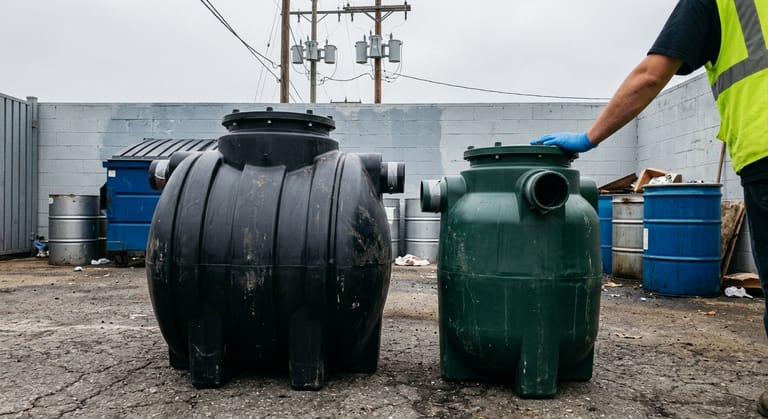
A Schier grease interceptor is a Great Basin unit: nine designations, GB1 through GB-1500, rated 25 to 200 GPM and 57 to 10,061 lbs of grease capacity.
Those designations appear on Schier's Great Basin product listing, grouped small (GB1 to GB3), medium (GB-50 to GB-250) and large (GB-500 to GB-1500). Ratings on this page were read off Schier paperwork, and wherever two Schier documents print different numbers against the same designation, both numbers appear below. For the unit already in the ground, calling (800) 555-0184 reaches a partner outfit that pumps these tanks; Silverbeck publishes and does not.
What the model designations mean
The number in a Great Basin name is not a rating: it is neither the GPM nor the pounds, and the manufacturer's sizing page lists the nine designations with no GPM rating or gallon capacity beside them. Take the real numbers from the model's own sheet.
Suffixes matter. Variants such as GB-1000-B and GB2-CT sit outside the nine base designations and carry their own ratings, so a quote returned with a suffix is a different sheet.
Hyphenation is inconsistent everywhere. A GB 75 grease interceptor is the same unit whether it is written GB-75 or GB75; the GB-2 grease interceptor is the GB2, and GB 50 is the GB-50.
Schier grease interceptor ratings across the Great Basin line
Rated flow and retention capacity for every Great Basin model, from the manufacturer's listing.
| Model | Rated flow, GPM | Rated grease capacity, lbs |
|---|---|---|
| GB1 | 25 | 57 |
| GB2 | 35 | 119 |
| GB3 | 50 | 268 |
| GB-50 | 50 / 75 | 439 / 287 |
| GB-75 | 75 | 861 |
| GB-250 | 100 / 150 | 1,895 / 1,848 |
| GB-500 | 100 / 200 | 3,271 / 2,969 |
| GB-1000 | 100 / 200 | 5,495 / 4,959 |
| GB-1500 | 100 / 200 | 10,061 / 9,446 |
The listing gives no liquid capacity in gallons and no efficiency basis for the pound figures; both sit on the individual sheets, which carry their own numbers. The GB-1000 shows 5,495 / 4,959 lbs above, while the GB-1000-B sheet, a suffix variant rather than the base model, states 3,939 lbs in its tank note and 3,681 lbs at 99.0% efficiency. On a submittal, use the sheet for the exact model.
How to read a GB-250 grease interceptor rating
Paired values are two selectable flow ratings for one tank, and the higher flow always buys the lower retention figure. The GB-250 grease interceptor is listed at 100/150 GPM with 1,895 and 1,848 lbs, one tank certified at two operating points rather than two products. The point you quote has to meet or exceed the flow your calculation produced, so 120 GPM is met by the 150 GPM point, and the capacity that comes with it is 1,848 lbs, not 1,895.
Talk to someone who opens these lids every week
Call (800) 555-0184Free to dial. Whoever answers pumps and services grease interceptors; ask for the registration number your city requires while you are on the call.Partner haulers and plumbers who work on food service drains- Partners who pump interceptors, not just unclog sinks
- Answered during the dinner rush
- Dialing costs nothing and books nothing
What a Schier Products grease interceptor spec sheet adds
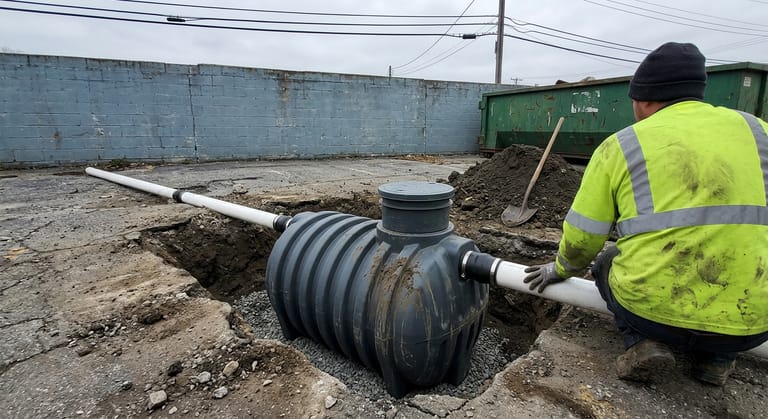
The GB-1000-B specification sheet (part 4080-025-01, drawing dated 4/5/2021) carries what a plan review runs on: a below grade polyethylene tank, a 6 inch plain end inlet and outlet, flow rates based on a 2 minute drain time, and no flow control required.
| Sheet line | Stated value |
|---|---|
| Title block | "200 GPM Polyethylene Grease Interceptor - 1,010 gallon capacity" |
| Rated flow | "Interceptor flow rate shall be 200 GPM." |
| Capacities note | "Capacities - Liquid: 1,010 gal.; Grease: 3,939 lbs. (540 gal.) Solids: 103 gal." |
| Grease capacity, engineer spec | "Interceptor grease capacity shall be 3,681 lbs." (504 gal.) at 99.0% efficiency |
| Operating limit | "Maximum operating temperature: 150° F continuous" |
| Certification | "... certified to ASME A112.14.3 (Type D) and CSA B481.1." |
The two grease figures are not interchangeable: 3,939 lbs is the tank capacity note, 3,681 lbs the certified figure tied to 99.0% efficiency. Type D is this model's classification, not the line's.
The same sheet rates units piped in series at 200 GPM, provided the top of the inlet diffuser on the first unit is sealed.
| Units in series | Rated grease capacity at 99% efficiency | Rated grease capacity at 98.5% efficiency |
|---|---|---|
| 2 | 7,362 lbs. | 7,878 lbs. |
| 3 | 11,043 lbs. | 11,817 lbs. |
| 4 | 14,724 lbs. | 15,756 lbs. |
Certifications the line claims
Look on the shop page for certification wording and it is not there. It sits on the specification sheet, and the paragraph is written for the whole Great Basin family rather than for one tank: third party performance tested and, in the manufacturer's phrasing, "listed by IAPMO to ASME #A112.14.3 and CSA B481.1 grease interceptor standards." Schier adds that the line runs well past what those standards ask for grease separation and storage, which is a sales comparison rather than part of any listing.
Two things the wording leaves out: the edition years of the standards, and any IAPMO file or listing number. ASME's catalog carries the document as A112.14.3/CSA B481.1, "Hydromechanical Grease Interceptors (w/ 12/22 Errata)", currently the 2022 edition, and the edition enforced where you cook may well be older.
What that buys a kitchen is narrow but real. A third party ran the model through the test rig behind those standards, so the flow and pound figures on the sheet are not a vendor bench number. It says nothing about whether the tank suits the grease your line actually produces, nothing about how often a hauler will have to pump it, and nothing about whether the reviewer handling your permit will accept that model on your drawings.
Matching a required rating to a model number
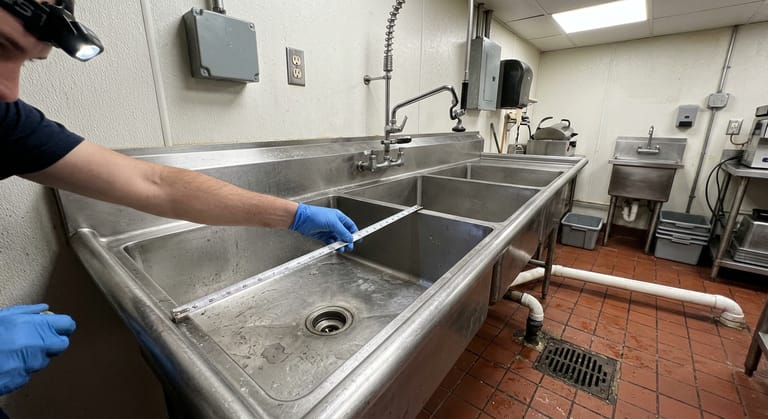
A model number means nothing until there is a required rating to hold it against. For a single compartment sink, Jay R. Smith's technical data works the fixture volume method through in four steps.
- Multiply the sink interior length by width by depth in inches. The published example, 48 by 24 by 12 inches, gives 13,824 cubic inches.
- Divide by 231 cubic inches per gallon: 59.8 gallons, brim full.
- Apply a 75 percent drainage load, since a sink never drains completely full: 44.9 gallons.
- Divide by the drainage period. One minute gives roughly 44.9 GPM, two minutes roughly 22.4 GPM.
The drainage period you pick roughly halves or doubles the number you carry into the table above. The method sizes a point of use hydromechanical unit rather than an in ground gravity tank, and the full version sits on the sizing page.
The manufacturer argues flow alone is the wrong basis: its sizing page promotes a Grease Production Sizing Method, and in the company's own words, "GPSM calculates how much grease a restaurant is likely to produce," matched to a workable pumpout interval. The formula is not published, so treat it as a vendor argument; capacity does drive how often the unit has to be pumped.
The check to run before you ask for a quote
Run the four steps at your own sink, then compare the result with the rating on the installed unit's submittal sheet. If the sheet says 35 GPM and the arithmetic says 45, the trap in the ground was never sized for the restaurant you run now. Never open or reach inside an in ground interceptor to look for a tag, since that entry is confined-space work and stays with the hauler. Pull the pumping records instead before asking a supplier to quote a Schier grease interceptor.
Other manufacturers
A Schier grease interceptor is one of several hydromechanical lines in US commercial kitchens, and each reads the same way: certified flow first, retention capacity second, model sheet over catalog page. The brands page sets them side by side.
Talk to someone who opens these lids every week
Call (800) 555-0184Free to dial. Whoever answers pumps and services grease interceptors; ask for the registration number your city requires while you are on the call.Partner haulers and plumbers who work on food service drains- Partners who pump interceptors, not just unclog sinks
- Answered during the dinner rush
- Dialing costs nothing and books nothing